![]() |
| |
![]() ![]() ![]() ![]() ![]() ![]() ![]() ![]() ![]() ![]() ![]() ![]() ![]()
| ||
| You are in: Virtual War Museum >> US Civil War Hall >> Robert Anderson | |
| |
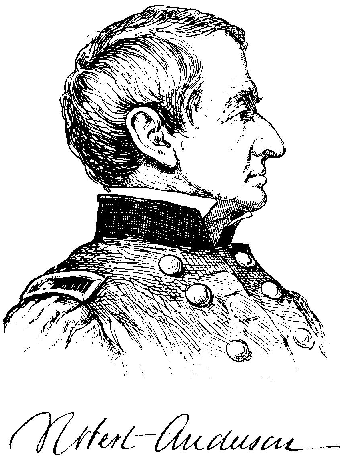
Robert
Anderson
1805-1871

Edited Appleton's American Image
Copyright©
2001 by VirtualologyTM
ANDERSON, Robert, soldier, born at "Soldier's Retreat," near Louisville, Kentucky, 14 June, 1805 ; died in Nice, France, 27 Oct., 1871. He graduated at West Point in 1825, and was appointed second lieutenant in the 3d artillery. He served in the Black Hawk war of 1832 as colonel of the Illinois volunteers. In 1835-'37 he was instructor of artillery at West Point, and in 1837-'38 he served in the Florida war, and was brevetted captain. Subsequently he was attached to the staff of General Scott as assistant adjutant-general, and was pro-rooted to captain in 1841.
He served in the Mexican war, and was severely wounded at Molino del Rey. In 1857 he was appointed major of the 1st artillery, and on 20 Nov., 1860, he assumed command of the troops in Charleston harbor, with headquarters at Fort Moultrie. Owing to threatened assaults, he withdrew his command, on the night of 26 Dec., to Fort Sumter, where he was soon closely invested by the confederate forces. On 13 April, 1861, he evacuated the fort, after a bombardment of nearly thirty - six hours from batteries to which he replied as long as his guns could be worked. He marched out, with his seventy men, with the honors of war, on the 14th, saluting his flag as it was hauled down, and sailed for New York on the following day.
In recognition of this service he was appointed Brigadier-General in the U. S. army by President Lincoln, and was assigned to the command of the department of Kentucky, and subsequently to that of the Cumberland. In consequence of failing health, he was relieved from duty in October, 1861. He was retired from active service 27 Oct., 1863, and on 3 Feb., 1865, he was brevetted Major-general.
He sailed for Europe in 1869 for his health, but died there. He translated and adapted from the French "Instructions for Field Artillery, Horse and Foot" (1840), and "Evolutions of Field Batteries" (1860), both of which have been used by the war department. It was largely owing to his personal efforts that the initial steps were taken organizing the Soldiers' Home in Washington, which now harbors about 2,000 veterans of the regular army.--His brother, Larz, capitalist, born near Louisville, Kentucky, 9 April, 1803; died in Cincinnati, Ohio, 27 Feb., 1878, was graduated at Harvard in 1822. He was a son-in-law of Nicholas Longworth, of Cincinnati, in which city he resided and was respected for his profuse charities and public spirit. -- Edited Appleton's American Biography Copyright© 2001 by VirtualologyTM
Research Links
Civil
War Union General Robert Anderson
Information on Civil War Union General Robert Anderson
Civil War
CDV's Union Brigader General Robert Anderson
RJ Balrog's Cards and Collectibles Union Brigader
General Robert Anderson . ...
Robert Anderson
Biography
... loyal to the Union, Robert Anderson was considered an ... 13. Forced to
surrender, Anderson
returned to the North ... He was appointed brigadier general, USA, on May 15 ...
General
Robert Anderson
General Robert Anderson. "Let us be ready for war.". General Robert
Anderson was
born in 1805 and died in 1871. Although he was born a southerner he fought for
...
General Robert
Anderson, Federal Army
General Robert Anderson, Federal Army (1805-1871). Robert
Anderson is most noted for his valiant ...
Robert
Anderson Civil War General
Robert Anderson Civil War General Savannah’s first police
chief By Timothy Daiss, When hostilities ...
portrait
of general robert anderson - federal commanding ...
... Brigadier General Robert Anderson. He was the commanding officer of Fort
Sumter at
the start of the war which he had to surrender after 34 hours of shelling on ...
William Tecumseh
Sherman
... H. Thomas were promoted to Brigadier General and were assigned to the
Department
of the Cumberland under the command of Brigadier-General Robert Anderson. ...
The United Colonies 1st
government began in a Philadelphia Tavern
and the United States 1st federal government ended in a
NYC Tavern!
The Founders convened the government in 11 different capitol buildings and
experienced 15 years of challenges that
included war,
hyper-inflation, a failed
constitution, judicial corruption, armed citizen and U.S. Army rebellions.

Click Here For United States Court of Appeals Update
Which U.S. President adopted
the Philadelphia Constitutional Convention
resolution, enacted the Northwest Ordinance, and backed George Washington,
James Madison and Nathaniel Gorham's resolution to submit the new U.S.
Constitution to the States for ratification without Congressional
alterations?
For A Unique
Vacation on Florida's Nature Coast
Click Here
The Coachman House Circa 1870 at Cedar Key
Unauthorized Site: This site and its contents are not affiliated, connected, associated with or authorized by the individual, family, friends, or trademarked entities utilizing any part or the subject's entire name. Any official or affiliated sites that are related to this subject will be hyper linked below upon submission and Evisum, Inc. review.
Copyright©
2000 by Evisum Inc.TM. All rights
reserved.
Evisum Inc.TM Privacy Policy
|
Search:
|
About Us |
|
|
![]() ![]() ![]() ![]() ![]() ![]() ![]() ![]() ![]() ![]() ![]() ![]() ![]()
![]()
| | |||