Who was
the First U.S. President? There were actually four first
Presidents
of the United Colonies and States of America Click Here
New Page 1
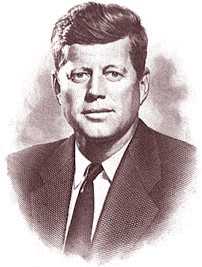
John F. Kennedy
45th
President of the United States
35th under the US Constitution
JOHN FITZGERALD KENNEDY was born in Brookline, Massachusetts on May 29,
1917, the second of the nine children of Joseph Patrick Kennedy and his wife,
Rose Fitzgerald Kennedy. Kennedy’s Irish ancestors had immigrated to Boston and
his grandfather, Patrick J. Kennedy, was a Boston political leader as well as a
successful businessman and saloonkeeper. His maternal grandfather, John F.
Fitzgerald was the mayor of Boston, popularly known as “Honey Fitz”. The
Kennedy’s lived in a modest but comfortable frame house, but as the family grew,
so did their father’s fortune. Joseph Kennedy had become quite wealthy by the
time he was 30 making his fortune in stock-market speculation, motion pictures,
shipbuilding and real estate. He also would hold several appointive positions in
the federal government during the Roosevelt administration, and his driving
ambition was to put a son in he White House.
Kennedy’s childhood was happy, even though he was always in the shadow of
his older brother Joseph, who dominated family competitions and was a better
student. Young Kennedy also was a frail child, with prolonged illnesses that
kept him from school. But despite his frequent illnesses, Kennedy was a good
athlete. At 13, young Kennedy attended the private Canterbury School in New
Milford, Connecticut. He became ill and never returned, graduating from Choate
Preparatory School in Wallingford, Connecticut in 1935. After spending that
summer studying at the London School of Economics, he entered Princeton
University, but again illness forced him home during the Christmas recess
because of an attack of jaundice. He resumed his studies in the fall of 1936 at
Harvard University, where he continued to be an easygoing student, concentrating
on swimming and with his brother Joe, won the intercollegiate sailing title.
Kennedy made two more trips to Europe in 1937 and in 1939 when his father was
serving as the United States Ambassador to Great Britain. Kennedy graduated cum
laude from Harvard in 1940, and he used his undergraduate thesis as the basis
for a book Why England Slept, which was a study of Britain’s response to German
rearmament prior to World War II. After graduating from Harvard, Kennedy spent a
few months studying at the Stanford University Graduate School of Business in
California.
In the spring of 1941, Kennedy volunteered for the Army, but was rejected
because of his degenerative back problem that had plagued him for years. During
that summer, he underwent a series of back strengthening exercises, and in
September the Navy accepted him. He sensed that if he did not participate in
World War II, he was not going to have much of a public life in this country,
and he wanted in. In March 1943, Kennedy took command of PT Boat 109 in the
South Pacific. To have a man with such frail health as Kennedy’s as your
commander could be dangerous and Kennedy should never have been there. However,
on the night of August 2, 1943, his boat was rammed by a Japanese destroyer in
the waters off New Georgia in the Solomon Islands. Kennedy was thrown across the
deck onto his back, the boat being sliced in half and two of the twelve men
aboard were killed immediately. Kennedy rallied the survivors and they clung to
the wreckage for hours, hoping for rescue. Giving up hope for an immediate
rescue, they swam three miles to a small island, with Kennedy towing a wounded
crewmember, clenching the strap of Pappy McNulty’s life jacket between his
teeth. The men remained on the island for four days, with Kennedy swimming daily
along a water route that the American ships used, hoping to find a rescue ship.
He finally encountered friendly natives on Cross Island that took a message for
help, carved on a coconut shell, to the U.S. infantry patrol. The men were
rescued and Kennedy was awarded the Purple Heart and the U.S. Navy and Marine
Corps Medal for heroism. However, the ordeal had aggravated his back and he
contracted malaria so he returned to the United States for medical treatment.
After an operation on his back, he was discharged early in 1945.
Kennedy’s father had groomed his first son, Joseph, for politics – Joe was
going to get the Kennedy’s into the White House. But young Joe was killed in
action in 1944, and after working as a reporter for the Hearst International
News Service, Kennedy decided to enter politics himself. His opportunity came
early in 1946, when he announced his candidacy for the Democratic nomination for
the House of Representatives seat for the 11th Congressional District of
Massachusetts. He ran against nine other candidates and won the primary with 42
percent of the votes. In November, he defeated his Republican opponent and
became a congressman at the age of 29, winning reelection in 1948 and 1950. In
1952, Kennedy decided to run against Republican Senator Henry Cabot Lodge, Jr.,
defeating him by more than 70,000 votes, in a campaign the entire Kennedy family
took part in.
On September 12, 1953, Kennedy married Jacqueline Lee Bouvier. The couple
had three children: Caroline Bouvier (1957 – ); John Fitzgerald, Jr. (1960 –
1999); and Patrick Bouvier, who died less than 48 hours after his birth on
August 7, 1963.
Increasingly troubled by his back, Kennedy underwent spinal surgery. Due
to the fact that Kennedy suffered from Addison’s disease, the surgery had to be
preformed in two separate procedures in October 1954 and again in February 1955.
During his long convalescence, he occupied himself by writing Profiles in
Courage, which was published in 1956 and received the Pulitzer Prize for
biography in 1957.
Kennedy returned to the Senate in May 1955 and by the beginning of 1956,
he aimed toward higher office. During he Democratic National Convention of that
year, he almost was nominated for the vice presidency running with Adlai
Stevenson, but he lost on the third ballot to Senator Estes Kefauver of
Tennessee. In 1958, Kennedy was reelected to the Senate, winning by the largest
margin ever recorded in a Massachusetts senatorial contest. He spoke frequently
throughout the country and in January 1960 he formally announced his candidacy
for President. By the time of the Democratic National Convention, he had already
won seven primary victories, overcoming opposition that a Roman Catholic could
not win in a predominantly Protestant state. He won the nomination and the
Kennedy/Lyndon B. Johnson ticket narrowly defeated their Republican opponents,
Richard M. Nixon/Henry Cabot Lodge, Jr. at the November elections. The margin
being only 119,450 votes out of the nearly 69,000,000 cast.
Kennedy was the first Roman Catholic and at the age of 43, the youngest
man ever elected President. Theodore Roosevelt was a few months younger than
Kennedy when he took office after William McKinley was assassinated in 1901, but
Kennedy was the youngest elected President. He was sworn in on January 20, 1961
and his inaugural address was widely acclaimed.
In April 1961, Kennedy supported a failed mission by anti-Castro Cuban
exiles at the Bay of Pigs. The next year, the Soviets put nuclear missiles in
Cuba, but withdrew them after Kennedy imposed a naval blockade. Tensions eased
somewhat with the Soviets with the 1963 nuclear test ban treaty, although the
“space race” continued. Kennedy was a strong supporter of the arts, while being
mindful of the disadvantaged. He and his wife attempted to make the White House
the cultural center of the nation. He was an avid reader and was particularly
interested in what the press had to say about his administration. He founded the
Peace Corps and proposed wide-ranging civil rights legislation, but never lived
to see its enactment.
On November 22, 1963, while on his way to make a luncheon speech in
Dallas, Texas, Kennedy and his wife sat in an open convertible waving to the
crowds who had gathered to greet him. Suddenly, as the motorcade approached an
underpass, an assassin fired several shots, striking the President in the neck
and head. He was pronounced dead at Parkland Memorial Hospital, never regaining
consciousness. The bullets that killed Kennedy were fired from the window of a
nearby warehouse. Dallas police arrested 24-year-old Lee Harvey Oswald for the
President’s murder. Two days later, on November 24 in the basement of the Dallas
police station, Oswald was fatally shot by Jack Ruby, a Dallas nightclub owner,
as millions watched on television.
On November 29, President Johnson appointed a commission to conduct a
thorough investigation of the assassination headed by Chief Justice Earl Warren.
The Warren Commission’s Report, made public on September 27, 1964, found no
evidence of a conspiracy in the assassination and concluded that “the shots
which killed President Kennedy and wounded Governor Connally were fired by Lee
Harvey Oswald.” However, in 1979, after two years of investigation, the House
assassinations committee concluded that Oswald probably was part of a conspiracy
that might have included members of organized crime.
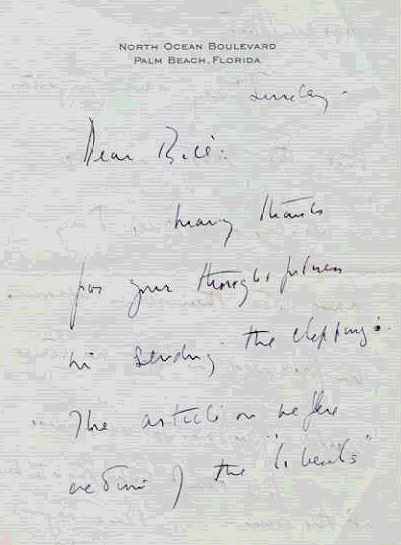
John F. Kennedy as President-Elect, Criticizing Liberals
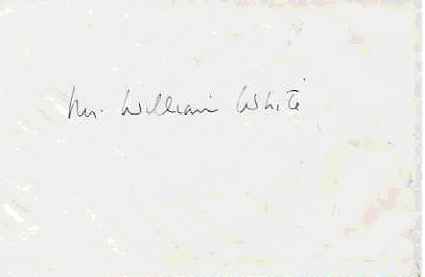
Autograph letter signed “Jack” to
William S. White, journalist, biographer and friend of Lyndon Johnson. White
had sent Kennedy some press clippings and Kennedy returned this note with his
thanks. Dated December 1960, 2 pages on pale gray North Ocean Boulevard Palm
Beach Florida letterhead, with accompanying envelope addressed, “Mr. William
White.”
Many thanks
for your thoughtfulness in sending the clippings. The article on reflex
reaction of the “liberals” was excellent.
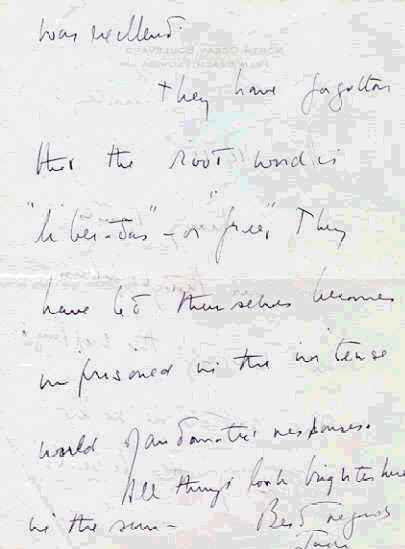
They have
forgotten that the root word is “liberalas” – or “free”. They have to
themselves become imprisoned in the intense world of automatic responses.
All things
look brighter here in the sun-
Best
regards,
Jack
Presidents of the Continental
Congress
United Colonies of The United States
Peyton Randolph September 5, 1774 to
October 22, 1774
and May 20 to May 24, 1775
Henry Middleton October 22, 1774 to October 26, 1774
The Vice President
Speaker of the House
President pro tempore of the Senate
Secretary of State
Secretary of the Treasury
Secretary of Defense
Attorney General
Secretary of the Interior
Secretary of Agriculture
Secretary of Commerce
Secretary of Labor
Secretary of Health and Human Services
Secretary of Housing and Urban Development
Secretary of Transportation
Secretary of Energy
Secretary of Education
Secretary of Veterans Affairs
Research Links
Virtualology is not affiliated with the authors of these links nor responsible
for its content.
Franklin D. Roosevelt Library and Museum - Repository of the records of
President Franklin Roosevelt and his wife Eleanor Roosevelt, managed by the
National Archives and Records Administration.
Dwight D. Eisenhower Presidential Library - preserves and makes available
for research the papers, audiovisual materials, and memorabilia of Dwight and
Mamie D. Eisenhower
Unauthorized Site:
This site and its contents are not affiliated, connected,
associated with or authorized by the individual, family,
friends, or trademarked entities utilizing any part or
the subject's entire name. Any official or affiliated
sites that are related to this subject will be hyper
linked below upon submission
and Evisum, Inc. review.
Please join us in our mission to incorporate The Congressional Evolution of the United States of America discovery-based curriculum into the classroom of every primary and secondary school in the United States of America by July 2, 2026, the nation’s 250th birthday. , the United States of America: We The
People. Click Here