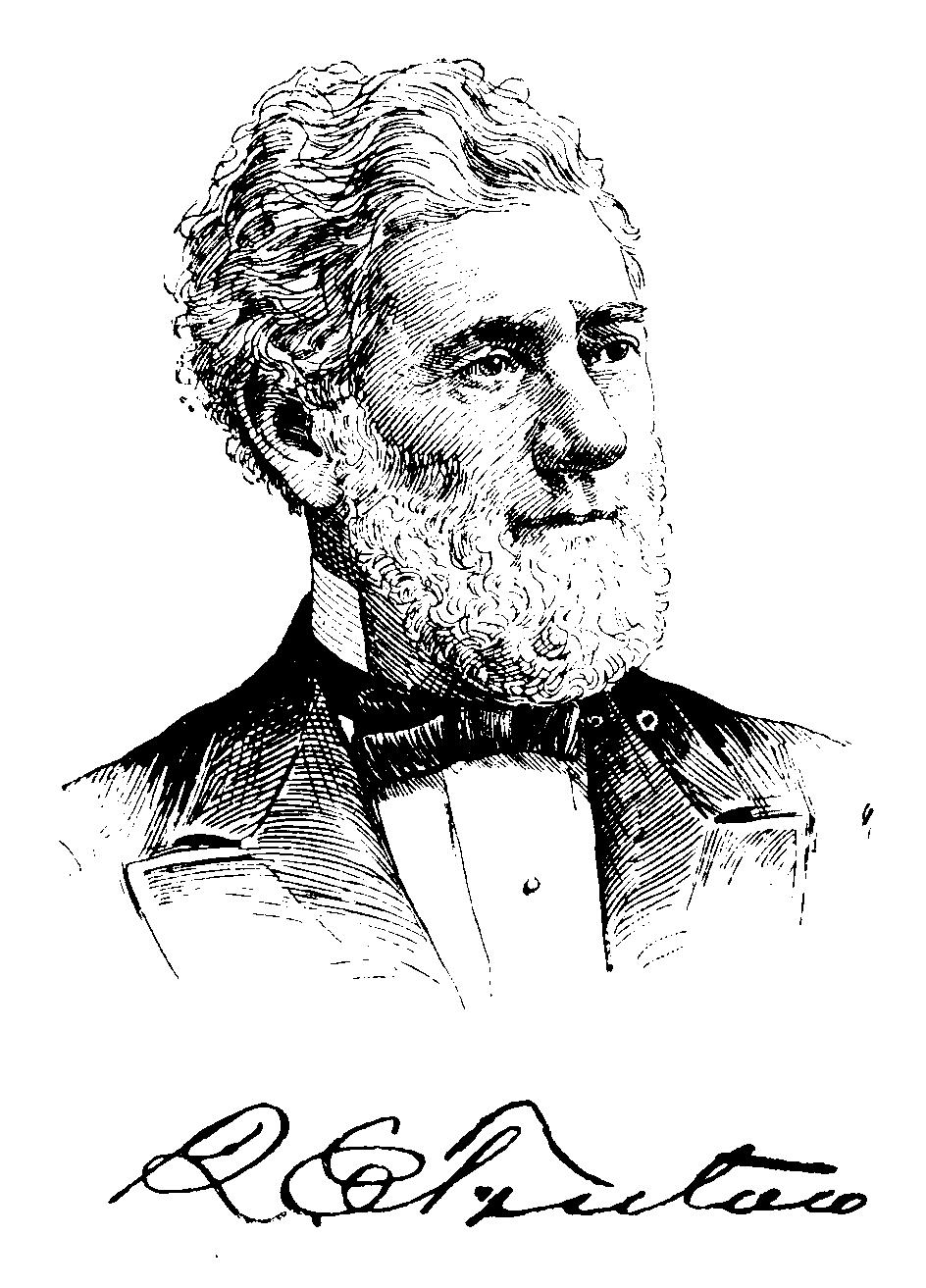
Appleton's Cyclopedia of American Biography, edited by James
Grant Wilson, John Fiske and Stanley L. Klos. Six volumes, New York: D. Appleton
and Company, 1887-1889 and 1999. Virtualology.com warns that these 19th Century
biographies contain errors and bias. We rely on volunteers to edit the historic
biographies on a continual basis. If you would like to edit this biographyplease
submit a rewritten biography in text form.
If acceptable, the new biography will be published above the 19th Century
Appleton's Cyclopedia Biography citing the volunteer editor
Virtual American Biographies
Over 30,000 personalities
with thousands of 19th Century illustrations, signatures, and exceptional life
stories. Virtualology.com
welcomes editing and additions to the
biographies. To become this site's editor or a contributor
Click Here
or e-mail Virtualology here.
FENTON, Reuben Eaton, statesman, born in Carroll, Chautauqua County, New York, 1 July 1819 ; died in Jamestown, New York, 25 August 1885. His early education was obtained at Pleasant Hill and Fredonia academies, in his native County. He was admitted to the bar in 1841, and began practice in Jamestown, but, finding law uncongenial, he engaged in mercantile pursuits, and in a few years acquired a moderate fortune. Meanwhile he took active interest in polities, and in 1843 was elected supervisor of the town of Carroll, which office he held for eight years. In l852 Mr. Fenton was elected to congress, and was active in the contest over the Kansas Nebraska bill, being one of the forty-four northern Democrats that voted against the further extension of slavery. This action resulted in his defeat in 1854, when the Whigs and Democrats nominated him against the Know-nothing candidate. The Republicans of his district nominated Mr. Fenton for congress in 1856, and a large majority elected him, serving from 1857 till 1864 when he resigned, having been chosen governor of his state. He heartily supported the cause of the Union in the civil war, and stood firmly by President Lincoln and his cabinet in their war measures.
He was inaugurated governor at the opening of the year 1865, and was reelected by an increased majority. In 1868 he was elected to succeed Edwin D. Morgan as U. S. senator, and served from 1869 to 1875. The only public trust held by him after leaving the senate was that of chairman of the U. S. commission at the International monetary conference in Paris in 1878. Mr. Fenton actively promoted the interests of the community in which he lived. He projected the bringing of two new railroads into Jamestown, and was one of the main contributors toward establishing there a Swedish orphanage. He also served a term as president of the village. His last public address was made on the occasion of General Grant's funeral, when a memorial service was held in Walnut Grove, his place of residence.
Unauthorized Site:
This site and its contents are not affiliated, connected,
associated with or authorized by the individual, family,
friends, or trademarked entities utilizing any part or
the subject's entire name. Any official or affiliated
sites that are related to this subject will be hyper
linked below upon submission
and Evisum, Inc. review.
Please join us in our mission to incorporate The Congressional Evolution of the United States of America discovery-based curriculum into the classroom of every primary and secondary school in the United States of America by July 2, 2026, the nation’s 250th birthday. , the United States of America: We The
People. Click Here