Appleton's Cyclopedia of American Biography, edited by James
Grant Wilson, John Fiske and Stanley L. Klos. Six volumes, New York: D. Appleton
and Company, 1887-1889 and 1999. Virtualology.com warns that these 19th Century
biographies contain errors and bias. We rely on volunteers to edit the historic
biographies on a continual basis. If you would like to edit this biographyplease
submit a rewritten biography in text form.
If acceptable, the new biography will be published above the 19th Century
Appleton's Cyclopedia Biography citing the volunteer editor
Virtual American Biographies
Over 30,000 personalities
with thousands of 19th Century illustrations, signatures, and exceptional life
stories. Virtualology.com
welcomes editing and additions to the
biographies. To become this site's editor or a contributor
Click Here
or e-mail Virtualology here.
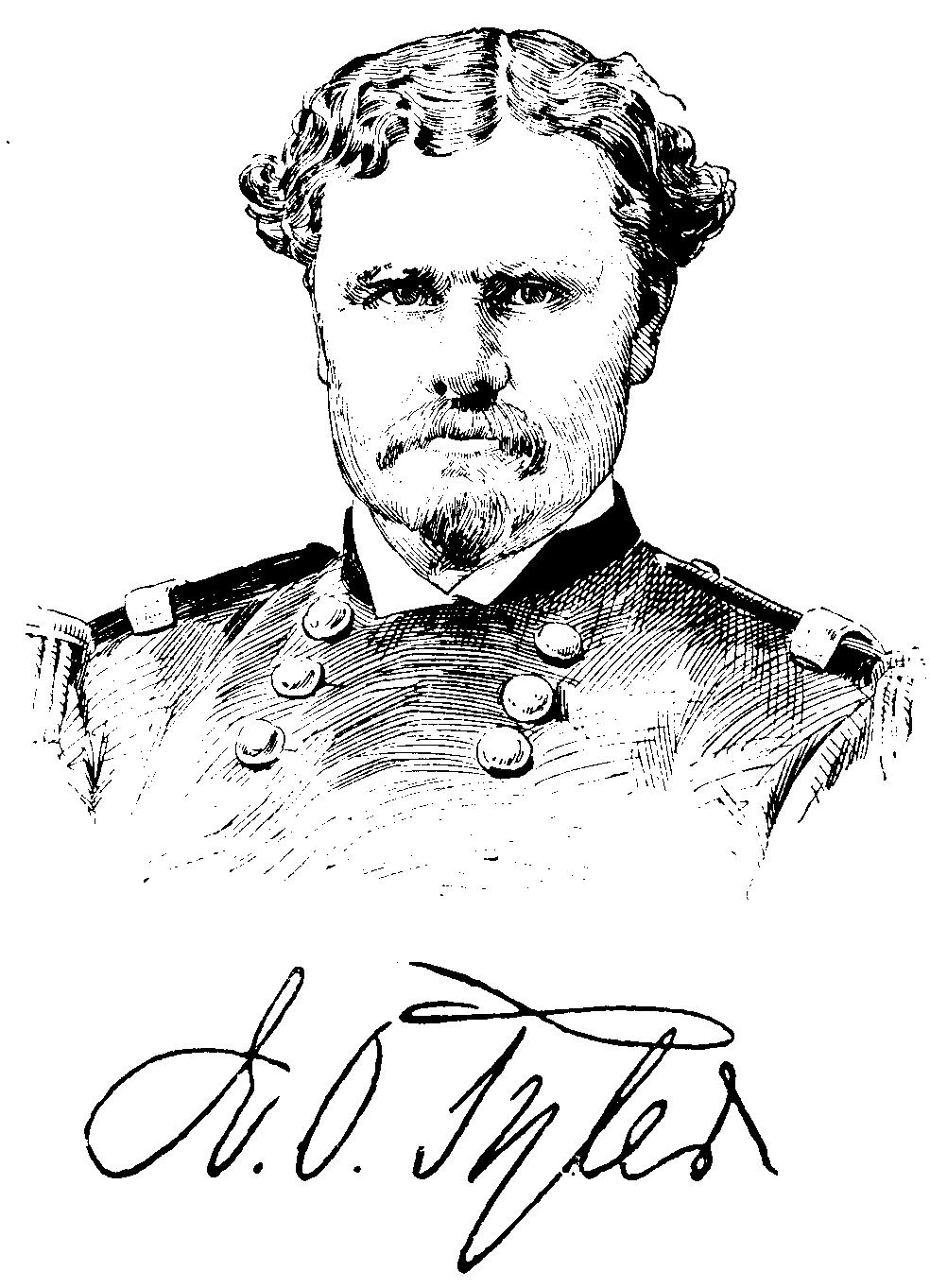
TYLER, Robert Ogden, soldier, born in Greene county, New York, 22 December, 1831; died in Boston, Massachusetts, 1 December, 1874. When he was seven years old his parents took him to Hartford, Connecticut, and he was appointed from that state to the United States military academy, where he was graduated in 1853. He was assigned to the 3d artillery, and served on frontier duty till the civil war, being engaged against hostile Indians in the Spokane expedition of 1858. In April, 1861, he was on the expedition to relieve Fort Sumter, and witnessed its bombardment, and on 17 May, after opening communication through Baltimore in command of a light battery, after the attack on the 6th Massachusetts regiment, he was made assistant quartermaster with rank of captain, and served in the defences of Washington. On 29 August, at the special request of the Connecticut authorities, he was allowed by the war department to undertake the reorganization of the 4th Connecticut regiment, which had become demoralized, and was commissioned its colonel. Under Col Tyler the regiment became one of the best in the army, and in January, 1862, it was made the 2d Connecticut heavy artillery. With it he took part in the peninsular campaign, and on 29 November, 1862, he was made brigadier-general of volunteers. At Fredericksburg he had charge of the artillery of the centre grand division and was brevetted major for gallantry, and on 2 May, 1863, he was given command of the artillery reserve of the Army of the Potomac. In this capacity he did efficient service at Chancellorsville, at Gettysburg, where two horses were shot under him, and in the Rapidan campaign. He was subsequently a division commander in the 22d corps, covering Washington, and in May, 1864, was assigned a division of heavy artillery that acted as infantry On 19 May, while on the extreme right in the actions about Spottsylvania, he drove back an attack of Ewell's corps, and was publicly thanked, with his men, by General Meade for "gallant conduct and brilliant success." At Cold Harbor he led a brigade of picked regiments and received a severe wound in the ankle which lamed him for life and permanently shattered his constitution. He saw no more active service. At the close of the war he had received the brevets of lieutenant-colonel for Gettysburg, colonel for Spottsylvania, major-general of volunteers and brigadier-general, United States army, for Cold Harbor, and major-general, United States army, for services throughout the war. The Connecticut legislature thanked him in a resolution, and the citizens of Hartford presented him with a sword After the war General Tyler served as chief in the quartermaster's department successively at Charleston, Louisville, San Francisco, New York city, and Boston, with the rank of lieutenant-colonel.
Unauthorized Site:
This site and its contents are not affiliated, connected,
associated with or authorized by the individual, family,
friends, or trademarked entities utilizing any part or
the subject's entire name. Any official or affiliated
sites that are related to this subject will be hyper
linked below upon submission
and Evisum, Inc. review.
Please join us in our mission to incorporate The Congressional Evolution of the United States of America discovery-based curriculum into the classroom of every primary and secondary school in the United States of America by July 2, 2026, the nation’s 250th birthday. , the United States of America: We The
People. Click Here