Appleton's Cyclopedia of American Biography, edited by James
Grant Wilson, John Fiske and Stanley L. Klos. Six volumes, New York: D. Appleton
and Company, 1887-1889 and 1999. Virtualology.com warns that these 19th Century
biographies contain errors and bias. We rely on volunteers to edit the historic
biographies on a continual basis. If you would like to edit this biographyplease
submit a rewritten biography in text form.
If acceptable, the new biography will be published above the 19th Century
Appleton's Cyclopedia Biography citing the volunteer editor
Virtual American Biographies
Over 30,000 personalities
with thousands of 19th Century illustrations, signatures, and exceptional life
stories. Virtualology.com
welcomes editing and additions to the
biographies. To become this site's editor or a contributor
Click Here
or e-mail Virtualology here.
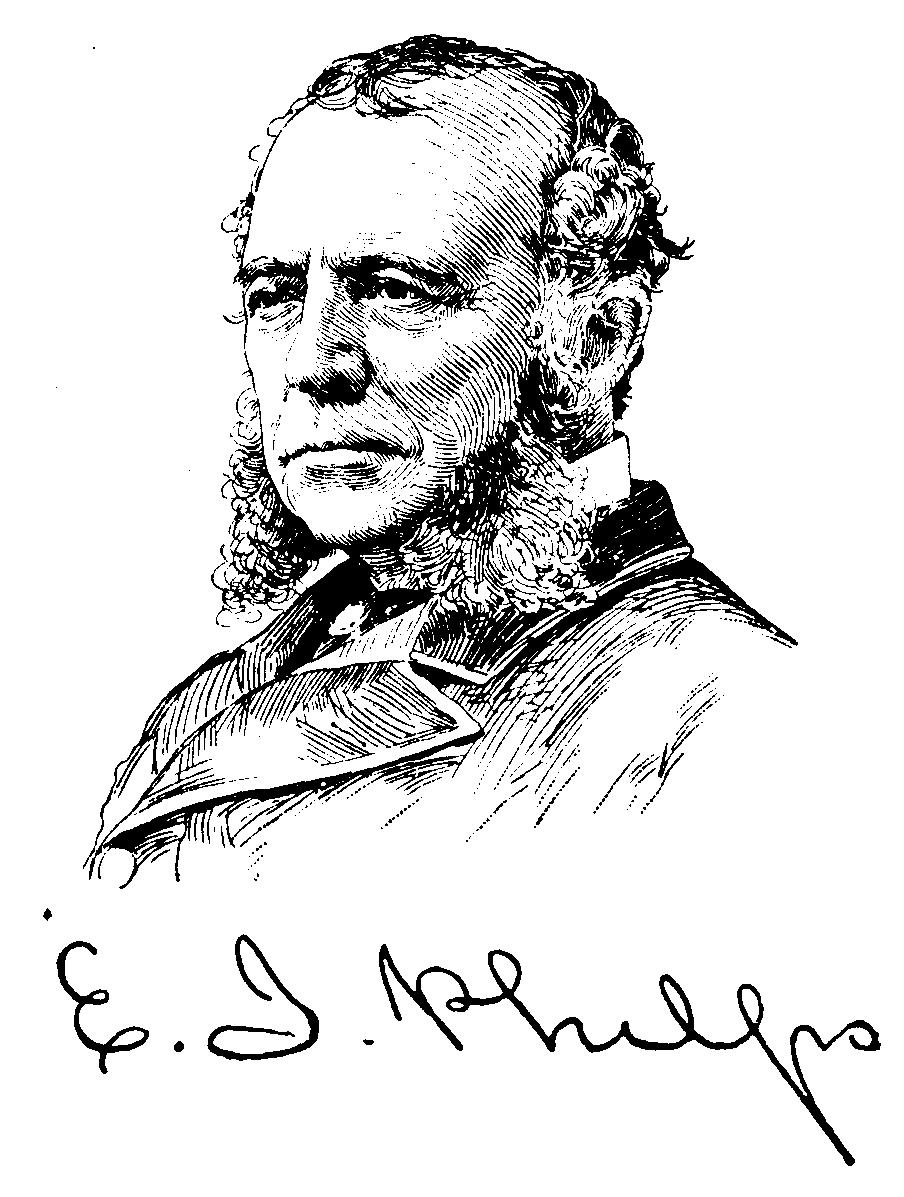
PHELPS, Samuel Shethar, jurist, born in Litchfield, Connecticut, 13 May, 1793; died in Middlebury, Vermont, 25 March, 1855. His grandfather, Edward, a descendant of William Phelps, the colonist, was a representative to the general court of Connecticut in 1744-'5, and a large landholder. His father, John, was a soldier of the Revolution and a wealthy citizen of Litchfield. The son was graduated at Yale in 1811, studied law in Litchfield, and in 1812 settled in Middlebury, Vermont, and began the practice of his profession. During the war with Great Britain he warmly espoused the cause of the government, was drafted to serve on the Canadian frontier, and subsequently became a paymaster. He resumed practice in 1814, was in the legislature in 1821-'32, by which body he was elected to the supreme court in the latter year, and held office until he was chosen to the United States senate as a Democrat in 1838, serving by re-election in 1839-'51, and by appointment in 1853-'4 to succeed William Upham, deceased. He opposed the abolition movements in his state, favored slavery in able speeches on the Clayton compromise and on the anti-slavery resolutions of Vermont, and when he was a member of the congressional committee of 1850 that was appointed to discuss the slavery question, dissented from the report that was presented by Henry Clay. At the end of his senatorial career he returned to practice, and continued to hold the first rank at the bar until his death. He published an "Address on the Council of Censors" (Middlebury, Vermont, 1827); "Speech on the Tariff Bill" (Washington, D. C., 1844); and "Speech on the Oregon Question" (1848). His published judicial decisions, in the Vermont reports, are much esteemed.--His son, Edward John, lawyer, born in Middlebury, Vermont, 11 July, 1822, was graduated at Middlebury college in 1840, studied law with Horatio Seymour after spending a year at Yale law-school, and was admitted to the bar at Middlebury in 1843. He began practice there, but in 1845 removed to Burlington, Vermont From 30 September, 1851, till the close of President Fillmore's administration he was the 2d comptroller of the treasury. He was a delegate to the Vermont constitutional convention of 1870. In 1877 he presided over the ceremonies for the centennial celebration of the battle of Bennington. In 1880 he delivered before the students of the medical department of the University of Vermont a course of lectures on medical jurisprudence that were published in book-form. He was president of the American bar association in 1880, and in the same year he was the unsuccessful candidate of the Democratic party for governor of Vermont. In 1881 he became professor of law at Yale, which chair he still (1888) holds, and in 1882 he lectured to the law students of Boston university on constitutional law. He was appointed by President Cleveland, in April, 1885, minister to Great Britain. Middlebury college conferred on him the degree of LL. D. in 1870. Among Professor Phelps's published addresses is one that he made before the American bar association on "Chief-Justice Marshall and the Constitutional Law of his Time" (Philadelphia, 1879). In 1888 he contributed to the "Nineteenth Century" a series of articles on "The Constitution of the United States."
Unauthorized Site:
This site and its contents are not affiliated, connected,
associated with or authorized by the individual, family,
friends, or trademarked entities utilizing any part or
the subject's entire name. Any official or affiliated
sites that are related to this subject will be hyper
linked below upon submission
and Evisum, Inc. review.
Please join us in our mission to incorporate The Congressional Evolution of the United States of America discovery-based curriculum into the classroom of every primary and secondary school in the United States of America by July 2, 2026, the nation’s 250th birthday. , the United States of America: We The
People. Click Here