Appleton's Cyclopedia of American Biography, edited by James
Grant Wilson, John Fiske and Stanley L. Klos. Six volumes, New York: D. Appleton
and Company, 1887-1889 and 1999. Virtualology.com warns that these 19th Century
biographies contain errors and bias. We rely on volunteers to edit the historic
biographies on a continual basis. If you would like to edit this biographyplease
submit a rewritten biography in text form.
If acceptable, the new biography will be published above the 19th Century
Appleton's Cyclopedia Biography citing the volunteer editor
Virtual American Biographies
Over 30,000 personalities
with thousands of 19th Century illustrations, signatures, and exceptional life
stories. Virtualology.com
welcomes editing and additions to the
biographies. To become this site's editor or a contributor
Click Here
or e-mail Virtualology here.
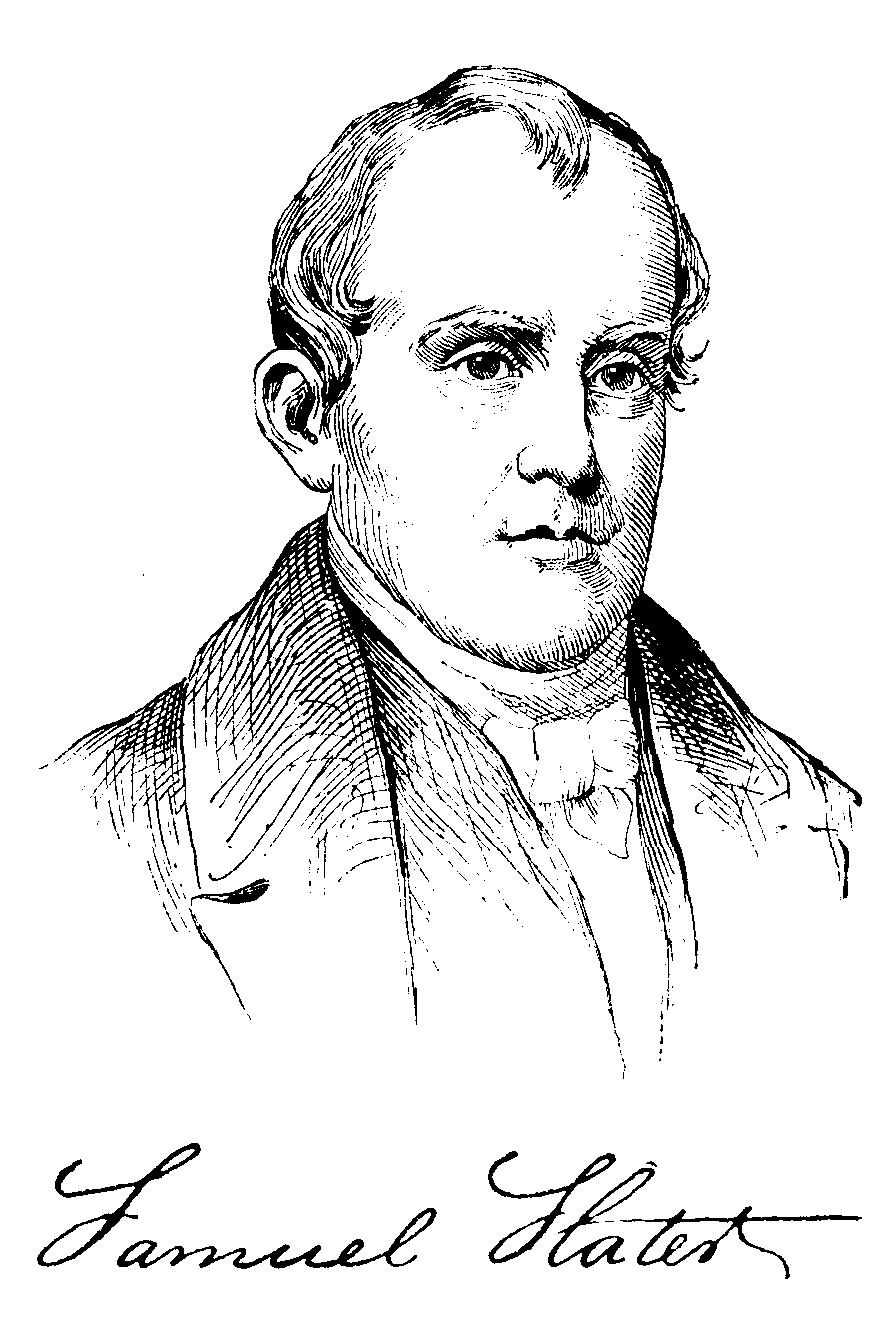
SLATER, Samuel, manufacturer, born in Belper, Derbyshire, England, 9 June, 1768; died in Webster, Massachusetts, 21 April, 1835. He was the son of a respectable yeoman, received a good education, and served an apprenticeship at cotton-spinning with Jedidiah Strutt, the partner of Richard Arkwright. He was a favorite with Mr. Strutt, aided him in making improvements in his mills, and gained a thorough mastery of the theory and practice of the new manufacture. In 1789 congress passed its first act for the encouragement of manufactures, and the legislature of Pennsylvania offered a bounty for the introduction of the Arkwright patent. Young S later became cognizant of these circumstances, and determined to introduce the invention in the United States; but, as the laws of England did not admit of his taking drawings or models with him, he had to trust to his memory to enable him to construct the most complicated machinery. He landed in New York in November, 1789, and, having ascertained that Moses Brown had made some attempts at cotton-spinning in Rhode Island, wrote to him and told him what he could do. Mr. Brown, in replying to him, wrote" "If thou canst do this thing, I invite thee to come to Rhode Island, and have the credit of introducing cotton-manufacture into America." Slater proceeded to Pawtucket, Rhode Island, in January, 1790, and immediately entered into articles of agreement with William Almy and Smith Brown to construct and operate the new cotton-spinning machinery. On 21 December, 1790, he started at Pawtucket three 18-inch carding-machines, the necessary drawing-heads with two rolls and four processes, the roving cases and winders for the same, and throstle spinning-frames of seventy-two spindles. In a short, time reels were made for putting the yarn into skeins, in which form it was at that time placed upon the market. In doing this Mr. Slater was compelled to prepare all the plans in the several departments of manufacturing, and to construct with his own hands the different kinds of machinery, or else teach others how to do it. The first yarn made on his machinery was equal to the best quality made in England. About 1800 the second cotton-mill went into operation in Rhode Island. In 1806 Mr. Slater was joined by his brother John, from England, and soon afterward a cotton-mill was erected in a locality now known as Slatersville, Rhode Island In 1812 Mr. Slater began the erection of mills in Oxford (now Webster), Massachusetts, adding in 1815-'16 the manufacture of woollen cloth. He was also interested in iron-manufactures, and acquired great wealth. In 1796 he established a Sunday-school for the improvement of his work-people, which was the first, or among the first, in the United States. See a memoir of him by George S. White (Philadelphia, 1836).--His nephew, John Fox, philanthropist, born in Slatersville, Rhode Island, 4 March, 1815" died in Norwich, Connecticut, 7 May, 1884, was the son of John Slater. He was early trained for the manufacturing business, and in 1872 became sole owner of the mill property he was then conducting, He made excellent investments, and in a few years acquired great wealth. Mr. Slater was early interested in the cause of education, and gave liberally for the establishment of the Norwich free academy and other objects. In April, 1882, he placed in the hands of trustees $1,000,000, the interest of which is to be used for the education of freedmen in the south.--His son, WILLIAM ALBERT, in November, 1886, transferred to the Free academy, Norwich, a building costing @150,000, which he erected in memory of his father.
Unauthorized Site:
This site and its contents are not affiliated, connected,
associated with or authorized by the individual, family,
friends, or trademarked entities utilizing any part or
the subject's entire name. Any official or affiliated
sites that are related to this subject will be hyper
linked below upon submission
and Evisum, Inc. review.
Please join us in our mission to incorporate The Congressional Evolution of the United States of America discovery-based curriculum into the classroom of every primary and secondary school in the United States of America by July 2, 2026, the nation’s 250th birthday. , the United States of America: We The
People. Click Here