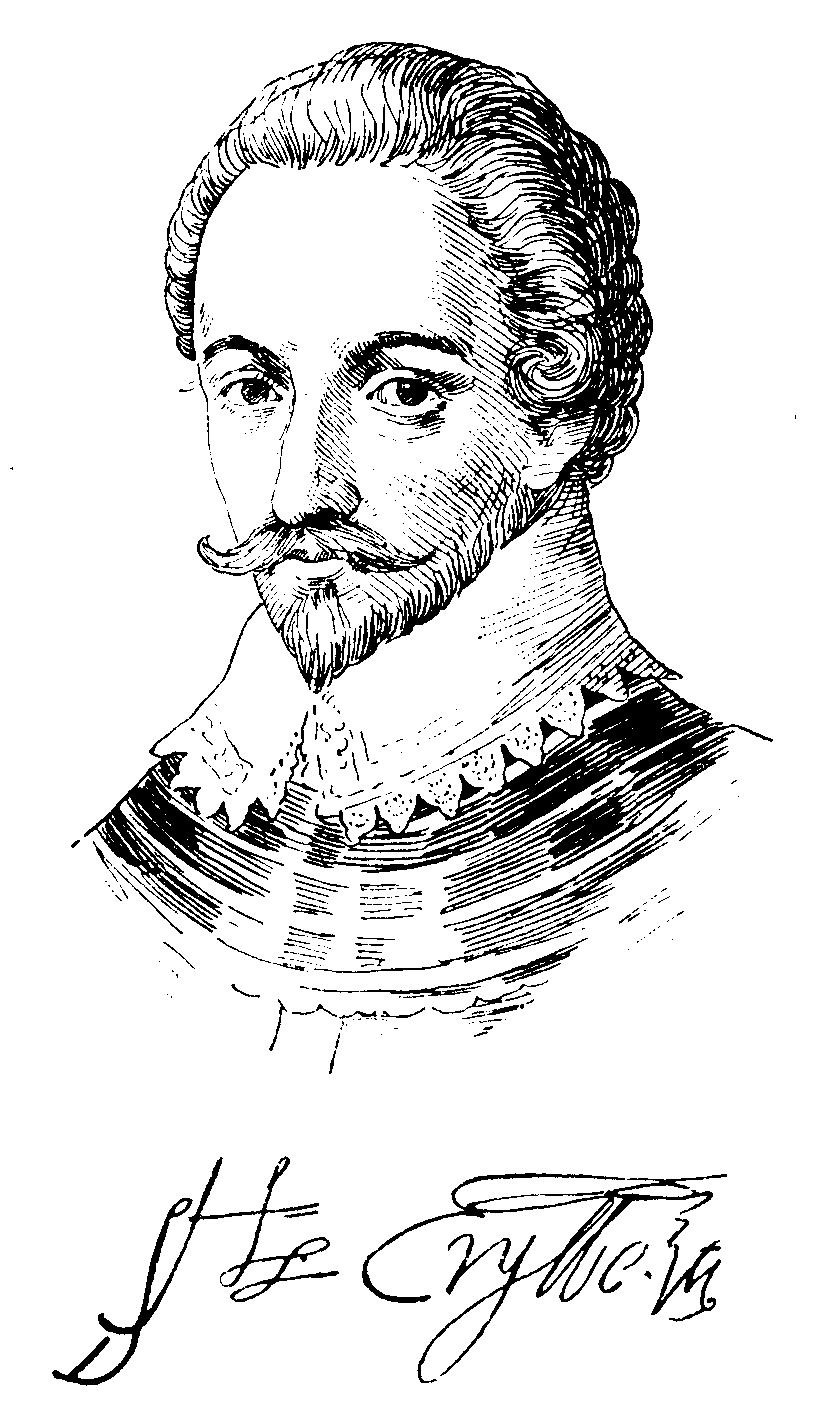
Appleton's Cyclopedia of American Biography, edited by James
Grant Wilson, John Fiske and Stanley L. Klos. Six volumes, New York: D. Appleton
and Company, 1887-1889 and 1999. Virtualology.com warns that these 19th Century
biographies contain errors and bias. We rely on volunteers to edit the historic
biographies on a continual basis. If you would like to edit this biographyplease
submit a rewritten biography in text form.
If acceptable, the new biography will be published above the 19th Century
Appleton's Cyclopedia Biography citing the volunteer editor
Virtual American Biographies
Over 30,000 personalities
with thousands of 19th Century illustrations, signatures, and exceptional life
stories. Virtualology.com
welcomes editing and additions to the
biographies. To become this site's editor or a contributor
Click Here
or e-mail Virtualology here.
GILBERT, Sir Humphrey, English navigator, born in Dartmouth, England, in 1539; lost at sea, 10 September, 1584. He was a half-brother of Sir Walter Raleigh. After studying at Eton and Oxford, he chose the military profession, fought in the north of England and Scotland against the Roman Catholics, and was given command of an army sent to subjugate the Irish. For his successful conduct of the campaign he was knighted and made governor of Munster in 1570. Soon after his return to England he commanded a fleet that was sent to blockade Flushing. On his return he published a pamphlet entitled "A Discourse of Discovery for a New Passage to Cataia." He was one of the most ardent advocates of the theory of a northwest passage, and after aiding Frobisher and other mariners with his fortune and influence, determined to become an explorer himself. He obtained letters-patent from Queen Elizabeth, authorizing him to make discoveries during six years in all barbarous countries not in the possession of Christians, and to occupy and dispose of them in favor of English subjects under the crown. His first expedition was undertaken in 1581, but a tern-pest destroyed one of his vessels, and compelled the admiral to return to port with the others, which were badly damaged. He mortgaged his estate to raise money for a new expedition, which started on 11 June, 1583, for Newfoundland. It consisted of two decked vessels and three sloops, manned by 260 men. Walter Raleigh, who commanded the largest ship, became alarmed at the amount of sickness on board, and on the third day put back for England. Gilbert arrived at the coast of Newfoundland after several narrow escapes from storms and icebergs. He landed at St. John, and, despite the presence of thirty-six vessels of various nationalities, took possession of the country in the name of his sovereign. He expelled the Portuguese, who had settled on the island, and published statutes providing that the religion of the country should follow the English rite, that whoever rebelled against the sovereignty of the queen should be punishable with death as a traitor, and that any person who spoke disrespectfully of the queen should have his ears cut off and his land or vessels confiscated. His colony turned out disastrously. A large number of sailors deserted, others fell sick, and finally Gilbert set sail for Norumbega afterward called New England. A tempest dispersed the flotilla, and the principal vessel foundered. Sir Humphrey's vessel went down in a storm off the Azores while on the course to England. Rob-err Clarke returned to Newfoundland alive, after great sufferings.
Unauthorized Site:
This site and its contents are not affiliated, connected,
associated with or authorized by the individual, family,
friends, or trademarked entities utilizing any part or
the subject's entire name. Any official or affiliated
sites that are related to this subject will be hyper
linked below upon submission
and Evisum, Inc. review.
Please join us in our mission to incorporate The Congressional Evolution of the United States of America discovery-based curriculum into the classroom of every primary and secondary school in the United States of America by July 2, 2026, the nation’s 250th birthday. , the United States of America: We The
People. Click Here