Appleton's Cyclopedia of American Biography, edited by James
Grant Wilson, John Fiske and Stanley L. Klos. Six volumes, New York: D. Appleton
and Company, 1887-1889 and 1999. Virtualology.com warns that these 19th Century
biographies contain errors and bias. We rely on volunteers to edit the historic
biographies on a continual basis. If you would like to edit this biographyplease
submit a rewritten biography in text form.
If acceptable, the new biography will be published above the 19th Century
Appleton's Cyclopedia Biography citing the volunteer editor
Virtual American Biographies
Over 30,000 personalities
with thousands of 19th Century illustrations, signatures, and exceptional life
stories. Virtualology.com
welcomes editing and additions to the
biographies. To become this site's editor or a contributor
Click Here
or e-mail Virtualology here.
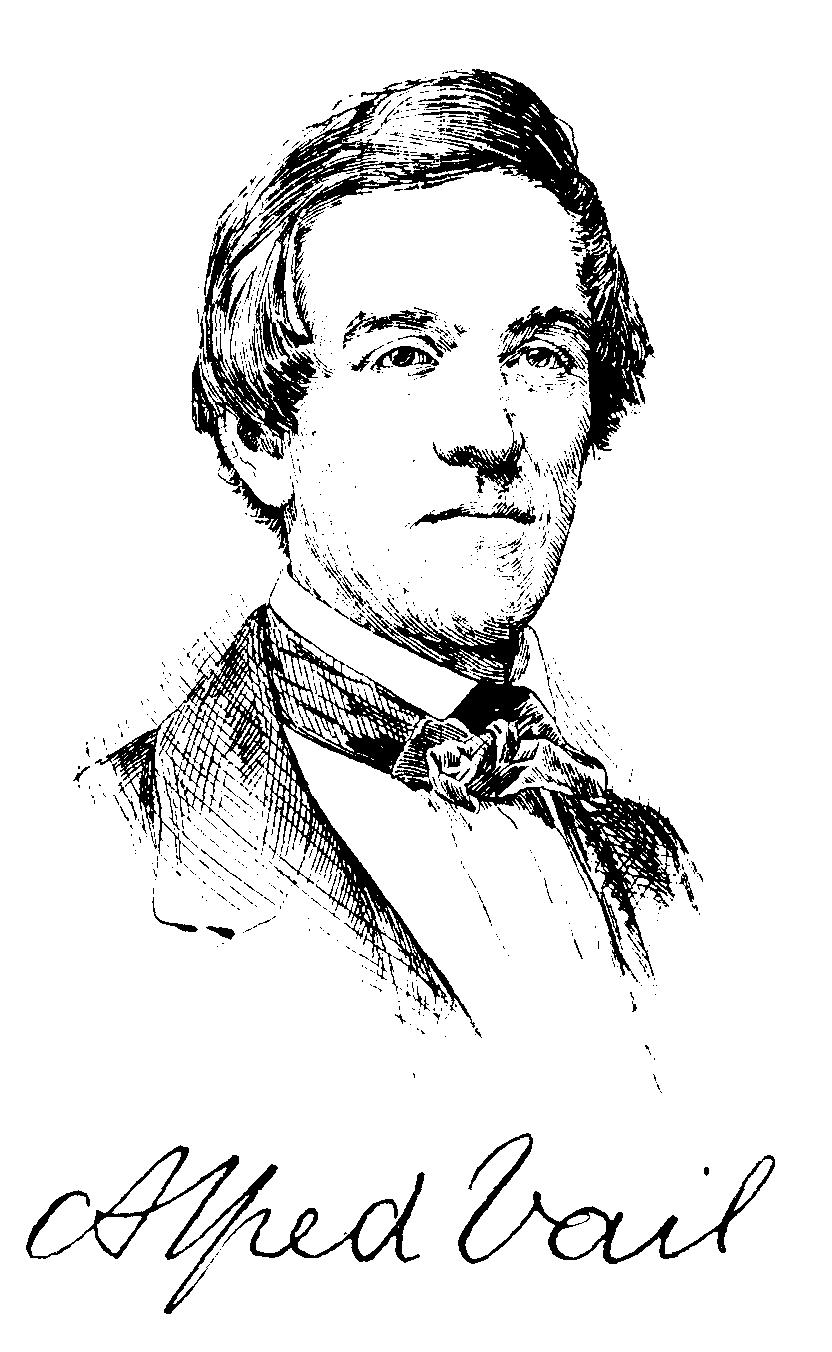
VAIL, Stephen, manufacturer, born near Morristown, New Jersey, 28 June, 1780; died there, 12 June, 1864. He received ordinary educational advantages, and in 1804 became the owner of the Speedwell ironworks, near Morristown, New Jersey At these works the engine of the "Savannah," the first steamship to cross the Atlantic (1819), was built. Later he contributed money to aid in the construction of the electric telegraph, and at his place the first practical exhibition of the new invention was made. He was one of the lay officers that are required on the local bench, and so acquired the title of judge.--His son, Alfred, inventor, born in Morristown, New Jersey, 25 September, 1807; died there, 18 January, 1859, was educated at Norris academy, and as a youth showed a fondness for study and investigation in natural science. In accordance with the wishes of his father, he entered the Speedwell iron-works, but on attaining his majority he determined to prepare for the Presbyterian ministry, and in consequence was graduated at the University of the city of New York in 1836. While in college he became interested in the experiments that Prof Samuel F. B. Norse was then conducting for the purpose of perfecting a system of telegraphy. Vail became convinced of the possibility of the scheme of electric communication, and his mechanical knowledge led to various suggestions on his part to Professor Morse. This acquaintance developed into an offer of partnership, and he obtained permission to invite Professor Morse to Speedwell, where he persuaded his father to contribute $2,000 toward the completion of the apparatus. In 1837 an agreement was signed by Mr. Vail, in which it was stipulated that he should construct at his own expense, and exhibit before a committee of congress, one of the telegraphs "of the plan and invention of Morse," and that he should give his time and personal services to the work and assume the expense of exhibiting the apparatus and of procuring patents in the United States. In consideration, Vail was to receive one fourth of all rights in the invention in this country. Thereafter, until congress appropriated money for the building of the initial line between Baltimore and Washington, Vail was active in developing the practical parts of the telegraph. His mechanical knowledge applied to the experimental apparatus resulted in the first available Morse machine. He invented the first combination of the horizontal lever motion to actuate a pen, pencil, or style, and then devised a telegraphic alphabet of dots, spaces, and dashes which it necessitated. The dot-and-dash system had already been invented by Morse for use in a code, but Mr. Vail claimed that he was the first to apply it alphabetically. He then devised in 1844 the lever and grooved roller, which embossed on paper the alphabetical characters that he originated. In March, 1843, he was appointed assistant superintendent of the telegraph that was to be constructed between Washington and Baltimore under the government appropriation. On the completion of the line he was stationed at Baltimore, and there invented the finger-key and received at the Mount Claire depot the first message from Washington that was sent over the wires, on 24 May, 1844, at the formal opening of the line. (See MOUSE, S. F.B.) The practical improvements in the original instrument that are of value in telegraphy were invented by Vail. Prior to 1837 the apparatus embodied the work of Morse and Joseph Henry alone. From 1837 to 1844 it was a combination of the inventions of Morse. Henry, and Vail, but gradually the parts that Morse contributed have been eliminated, so that the essential features of the telegraph of to-day consist solely of the work of Joseph Henry and Alfred Vail. The business relations that existed between Morse and Vail made it impossible for the latter to claim what might have been used against the validity of Norse's patents. In the years that followed, when Professor Morse was universally hailed as the inventor of the telegraph, the reputation of his modest partner was allowed to suffer. Amos Kendall, the associate and friend of both, said, at the meeting of the directors of the Magnetic telegraph company that was held to take action on the death of Mr. Vail: "If justice be done, the name of Alfred Vail will forever stand associated with that of Samuel F. B. Morse in the history and introduction into public use of the electro-magnetic telegraph." Mr. Vail was the author of " The American Electro-Magnetic Telegraph" (Philadelphia, 1845).--His brother, George, congressman, born in Morristown, New Jersey, 21 July, 1809 ; died there, 23 May, 1875, received an academic education, and was associated with his father in the Speedwell iron-works. He also aided his brother, Alfred, with funds when the latter was engaged in perfecting the electric telegraph. In 1851 he was appointed by the governor of New Jersey to represent that state at the World's fair in London. Subsequently he was chosen to congress as a Democrat, and with re-election served from 5 December, 1853, till 3 March, 1857. In 1858 he was appointed United States consul at Glasgow, Scotland, but he returned to this country in 1861, settled in Morristown, New Jersey, and was for many years a member of the court of pardons.
Unauthorized Site:
This site and its contents are not affiliated, connected,
associated with or authorized by the individual, family,
friends, or trademarked entities utilizing any part or
the subject's entire name. Any official or affiliated
sites that are related to this subject will be hyper
linked below upon submission
and Evisum, Inc. review.
Please join us in our mission to incorporate The Congressional Evolution of the United States of America discovery-based curriculum into the classroom of every primary and secondary school in the United States of America by July 2, 2026, the nation’s 250th birthday. , the United States of America: We The
People. Click Here