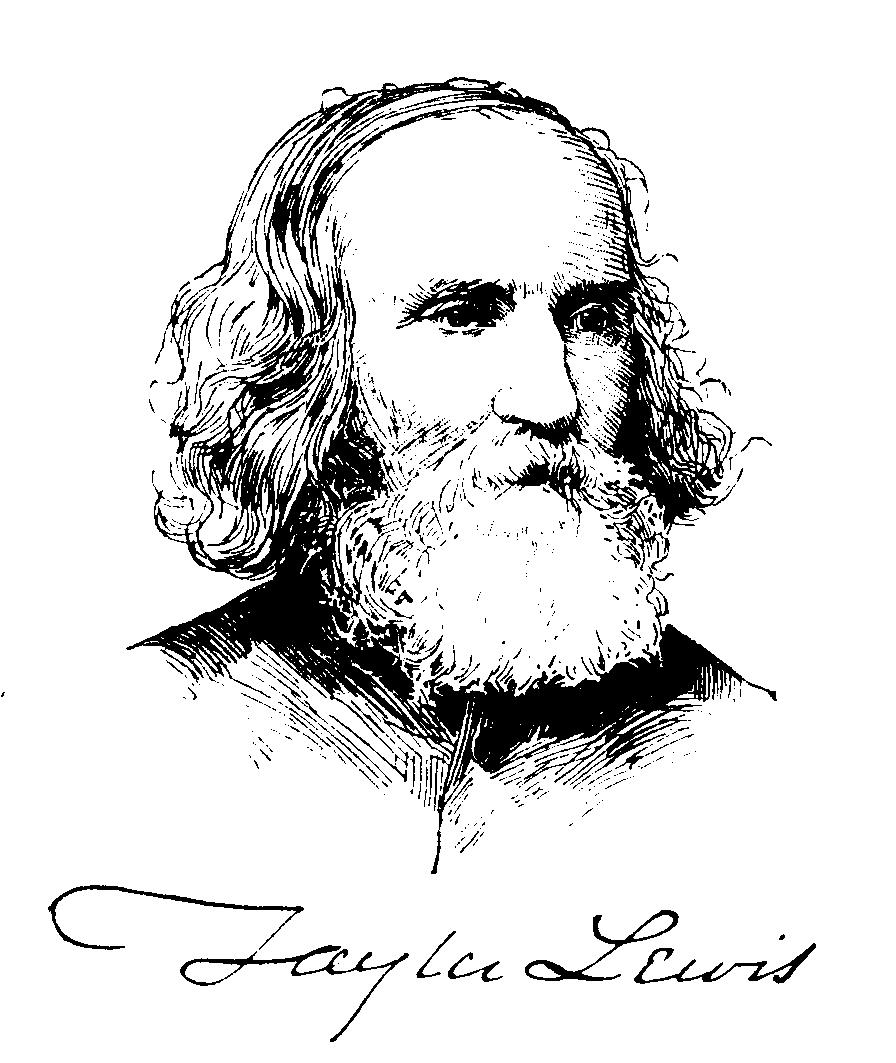
Appleton's Cyclopedia of American Biography, edited by James
Grant Wilson, John Fiske and Stanley L. Klos. Six volumes, New York: D. Appleton
and Company, 1887-1889 and 1999. Virtualology.com warns that these 19th Century
biographies contain errors and bias. We rely on volunteers to edit the historic
biographies on a continual basis. If you would like to edit this biographyplease
submit a rewritten biography in text form.
If acceptable, the new biography will be published above the 19th Century
Appleton's Cyclopedia Biography citing the volunteer editor
Virtual American Biographies
Over 30,000 personalities
with thousands of 19th Century illustrations, signatures, and exceptional life
stories. Virtualology.com
welcomes editing and additions to the
biographies. To become this site's editor or a contributor
Click Here
or e-mail Virtualology here.
LEWIS, Tayler, scholar, born in Northumberland, Saratoga County, New York, in 1802; died in Schenectady, New York, 11 May, 1877. His father was a Revolutionary officer. Tayler was graduated at Union in 1820, studied law, and began practice at Fort Miller, New York He gave a large part of his time to biblical and classical studies for nearly ten years, and at length abandoned the practice of law, and in 1833 opened a classical school at Waterford, New York, whence, in 1835, he removed to a school in Ogdensburg, New York He became professor of Greek in the University of New York in 1838, and from 1849 until his death was professor of Greek, instructor in the oriental tongue, and lecturer on biblical and oriental literature at Union college. In 1851-'6 he contributed many articles to the "Editor's Table" of "Harper's Magazine." Union gave him the degree of LL.D. in 1844. Professor Lewis had a wide acquaintance with the Greek and Latin classics, Arabic and Syriac, and the works of the Hebrew rabbis, and was especially interested in the system of Plato. His works, besides numerous discussions on social and political topics, are "Defence of Capital Punishment," with George B. Cheerer (New York, 1845); the Greek text of the tenth book of Plato's dialogue, "The Laws," under the title of "Platonic Theology, or Plato against the Atheists," with critical and explanatory notes and illustrative dissertations that show profound learning (1845); "The Six Days of Creation," his best-known work, maintaining, on philological grounds, the harmony of Scripture and geology (1855); "The Bible and Science," replying to criticisms on the preceding work (1856); "The Divine Human in the Scriptures" (1860); "States Rights, a Photograph of the Ruins of Ancient Greece" (1864); "Heroic Periods in a Nation's History" (1866); "Special Introduction to Genesis," with commentary on chapters i. to xi., and xxxvii, to 1., inclusive, in "Lange's Commentary" (1868); "Rhythmetical Version of Ecclesiastes" (1870); with Edward W. Blyden and Timothy Dwight, "The People of Africa, their Character, Condition, and Future Prospects" (1871); "The Light by which we see Light," the Vedder lectures (1875); "Memories of President Nott" (1876); and numerous addresses and reviews.
Unauthorized Site:
This site and its contents are not affiliated, connected,
associated with or authorized by the individual, family,
friends, or trademarked entities utilizing any part or
the subject's entire name. Any official or affiliated
sites that are related to this subject will be hyper
linked below upon submission
and Evisum, Inc. review.
Please join us in our mission to incorporate The Congressional Evolution of the United States of America discovery-based curriculum into the classroom of every primary and secondary school in the United States of America by July 2, 2026, the nation’s 250th birthday. , the United States of America: We The
People. Click Here