Appleton's Cyclopedia of American Biography, edited by James
Grant Wilson, John Fiske and Stanley L. Klos. Six volumes, New York: D. Appleton
and Company, 1887-1889 and 1999. Virtualology.com warns that these 19th Century
biographies contain errors and bias. We rely on volunteers to edit the historic
biographies on a continual basis. If you would like to edit this biographyplease
submit a rewritten biography in text form.
If acceptable, the new biography will be published above the 19th Century
Appleton's Cyclopedia Biography citing the volunteer editor
Virtual American Biographies
Over 30,000 personalities
with thousands of 19th Century illustrations, signatures, and exceptional life
stories. Virtualology.com
welcomes editing and additions to the
biographies. To become this site's editor or a contributor
Click Here
or e-mail Virtualology here.
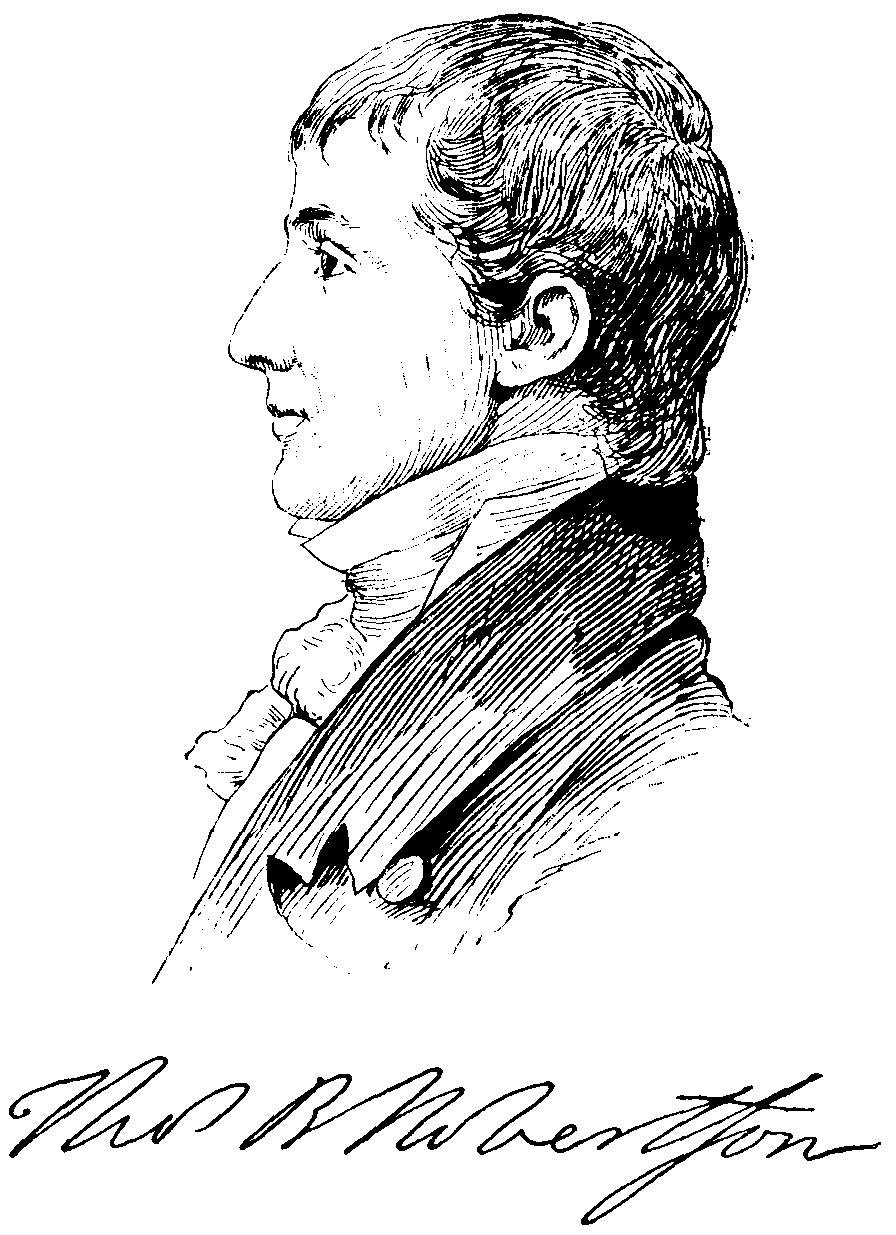
ROBERTSON, Thomas Bolling, governor of Louisiana, born near Petersburg, Virginia, in 1773; died in White Sulphur Springs, Virginia, 5 November, 1828. He was graduated at William and Mary in 1807, became a lawyer, and removed to New Orleans on receiving the appointment of secretary for the territory of Louisiana. He was elected as the first congressman from that state by the Democrats, and was returned for the three succeeding terms, serving from 23 December, 1812, till 1818, in which year he resigned his seat. Soon afterward he was elected governor. Resuming practice in New Orleans on the expiration of his term, he was soon made attorney-general, and shortly afterward appointed United States judge for the district of Louisiana. While visiting Paris during the last days of the empire, he wrote letters to his family, which were published in the Richmond "Enquirer," and in book-form under the title of "Events in Paris" (Philadelphia, 1816).-His brother, John, jurist, born near Petersburg, Virginia, in 1787; died in Mount Athos, Campbell County, Virginia, 5 July, 1873, was educated at William and Mary, studied law, was admitted to the bar, early gained a good position in his profession, and was appointed attorney-general of the state. He was elected to congress for three successive terms, serving from 8 December, 1834, till 3 March, 1839. He was judge of the circuit court for many years. Although a strong believer in the doctrines of the Jeffersonian school, he deprecated civil war, and at the beginning of the secession troubles was sent by Virginia to dissuade the southern states from extreme measures at the same time that John Tyler was despatched on a similar errand to President Buchanan. He published a tragedy called "Riego, or the Spanish Martyr" (Richmond, 1872), and a volume of occasional verses under the title of " Opuscula."--Another brother, Wyndham, governor of Virginia, born in Manchester, Chesterfield County, Virginia, 26 January, 1803-d. in Washington county, Virginia, 11 February, 1888, was educated at William and Mary, studied law, was admitted to practice in 1824, and established himself in Richmond. He was chosen a councillor of state in 1830, and in 1833 was again elected to the council, which was reduced to three members. He became lieutenant-governor on 31 March, 1836, and on the same day succeeded to the governorship for one year through the resignation of Little-ton W. Tazewell. In 1838 he was elected to the legislature, and represented the city of Richmond until he removed to the country in 1841. Returning to the capital in 1858, he was again elected to the legislature, and took an active part in its deliberations during the period of the civil war. He resisted the proposal of South Carolina for a southern convention in 1859, and after the secession of that state and others he still urged the refusal of Virginia to join them. As chairman of a. committee, he was the author of the anti-coercion resolution, in which Virginia, while rejecting secession, declared her intention to fight with the southern states if they were attacked. He opposed the regulation of the prices of food in 1863, and offered his resignation in 1864 when the public demanded such a measure, but resumed his seat on receiving a vote of approval from his constituents. He was the author of "Pocahontas, alias Matoaka, and her Descendants through her Marriage with John Rolfe" (Richmond, 1887). He left in manuscript a "Vindication of the Course of Virginia throughout the Slave Controversy."
Unauthorized Site:
This site and its contents are not affiliated, connected,
associated with or authorized by the individual, family,
friends, or trademarked entities utilizing any part or
the subject's entire name. Any official or affiliated
sites that are related to this subject will be hyper
linked below upon submission
and Evisum, Inc. review.
Please join us in our mission to incorporate The Congressional Evolution of the United States of America discovery-based curriculum into the classroom of every primary and secondary school in the United States of America by July 2, 2026, the nation’s 250th birthday. , the United States of America: We The
People. Click Here