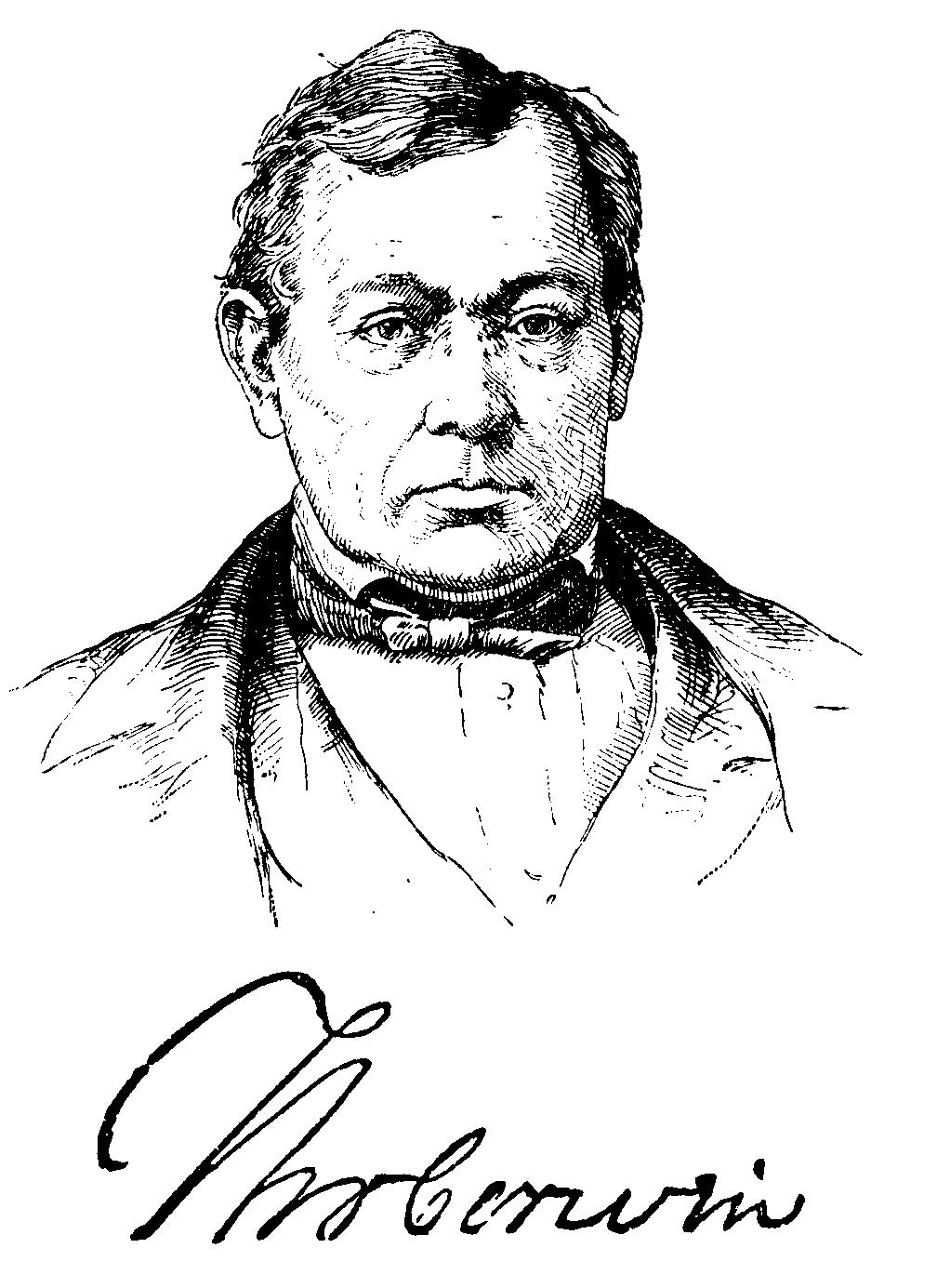
Appleton's Cyclopedia of American Biography, edited by James
Grant Wilson, John Fiske and Stanley L. Klos. Six volumes, New York: D. Appleton
and Company, 1887-1889 and 1999. Virtualology.com warns that these 19th Century
biographies contain errors and bias. We rely on volunteers to edit the historic
biographies on a continual basis. If you would like to edit this biographyplease
submit a rewritten biography in text form.
If acceptable, the new biography will be published above the 19th Century
Appleton's Cyclopedia Biography citing the volunteer editor
Virtual American Biographies
Over 30,000 personalities
with thousands of 19th Century illustrations, signatures, and exceptional life
stories. Virtualology.com
welcomes editing and additions to the
biographies. To become this site's editor or a contributor
Click Here
or e-mail Virtualology here.
CORWIN, Thomas, statesman, born in Bourbon county, Kentucky, 29 July, 1794; died in Washington, District of Columbia, 18 December, 1865. In 1798 his father, Matthias, removed to what is now Lebanon, Ohio, and for many years represented his district in the legislature. The son worked on the home farm till he was about twenty years old, and enjoyed very slender educational' advantages, but began the study of law in 1815, and was admitted to the bar in May, 1818. His ability and eloquence as an advocate soon gained him an extensive practice. He was first chosen to the legislature of Ohio in 1822, serving seven years, and was chosen to congress in 1830, from the Miami district as a Whig, of which party he was an enthusiastic member. His wit and eloquence made him a prominent member .of the house of representatives, to which he was re-elected by the strong Whig constituency that he represented for each successive term till 1840, when he resigned to become the Whig candidate for governor of Ohio, and canvassed the state with General Harrison, addressing large gatherings in most of the counties. He was unsurpassed as an orator on the political platform or before a jury. At the election he was chosen by 16,000 majority, General Harrison receiving over 23,000 in the presidential election that soon followed. Two years later, Governor Corwin was defeated for governor by Wilson Shannon, whom he had so heavily beaten in 1840. In 1844 the Whigs again carried the state, giving its electoral vote to Mr. Clay, and sending Mr. Corwin to the United States senate, where he made in-1847 a notable speech against the war in Mexico. He served in the senate until Mr. Fillmore's accession to the presidency in July, 1850, when he was called to the head of the treasury. After the expiration of Mr. Fillmore's term he returned to private life and the practice of law at Lebanon, Ohio. In 1858 he was returned once more a representative in congress by an overwhelming majority, and was re-elected with but slight opposition in 1860. On Mr. Lincoln's accession to the presidency he was appointed minister to Mexico, where he remained until the arrival of Maximilian, when he came home on leave of absence, and did not return, remaining in Washington and practicing law, but taking a warm interest in public affairs, and earnestly co-operating in every effort to restore peace. His style of oratory was captivating, and his genial and kindly nature made him a universal favorite. His intemperate speech against the Mexican war hindered his further political advancement. He was a faithful public servant, led a busy life, lived frugally, and, although he had been secretary of the United States treasury, failed to secure a competency for his family. See the "Life and Speeches" of Thomas Corwin, edited by Isaac Strohn (Dayton, 1859).--His brother, Moses B., born in Bourbon county, Kentucky, 5 January, 1790 ; died in Urbana, Ohio, 7 April, 1872, received a common-school education, studied law, was admitted to the bar in 1812, and practiced at Urbana. He was a member of the legislature in 1838-'9, and was elected as a Whig to congress in 1848, against his son, John A., who was nominated as a Democrat. He was again elected in 1854.
Unauthorized Site:
This site and its contents are not affiliated, connected,
associated with or authorized by the individual, family,
friends, or trademarked entities utilizing any part or
the subject's entire name. Any official or affiliated
sites that are related to this subject will be hyper
linked below upon submission
and Evisum, Inc. review.
Please join us in our mission to incorporate The Congressional Evolution of the United States of America discovery-based curriculum into the classroom of every primary and secondary school in the United States of America by July 2, 2026, the nation’s 250th birthday. , the United States of America: We The
People. Click Here