Appleton's Cyclopedia of American Biography, edited by James
Grant Wilson, John Fiske and Stanley L. Klos. Six volumes, New York: D. Appleton
and Company, 1887-1889 and 1999. Virtualology.com warns that these 19th Century
biographies contain errors and bias. We rely on volunteers to edit the historic
biographies on a continual basis. If you would like to edit this biographyplease
submit a rewritten biography in text form.
If acceptable, the new biography will be published above the 19th Century
Appleton's Cyclopedia Biography citing the volunteer editor
Virtual American Biographies
Over 30,000 personalities
with thousands of 19th Century illustrations, signatures, and exceptional life
stories. Virtualology.com
welcomes editing and additions to the
biographies. To become this site's editor or a contributor
Click Here
or e-mail Virtualology here.
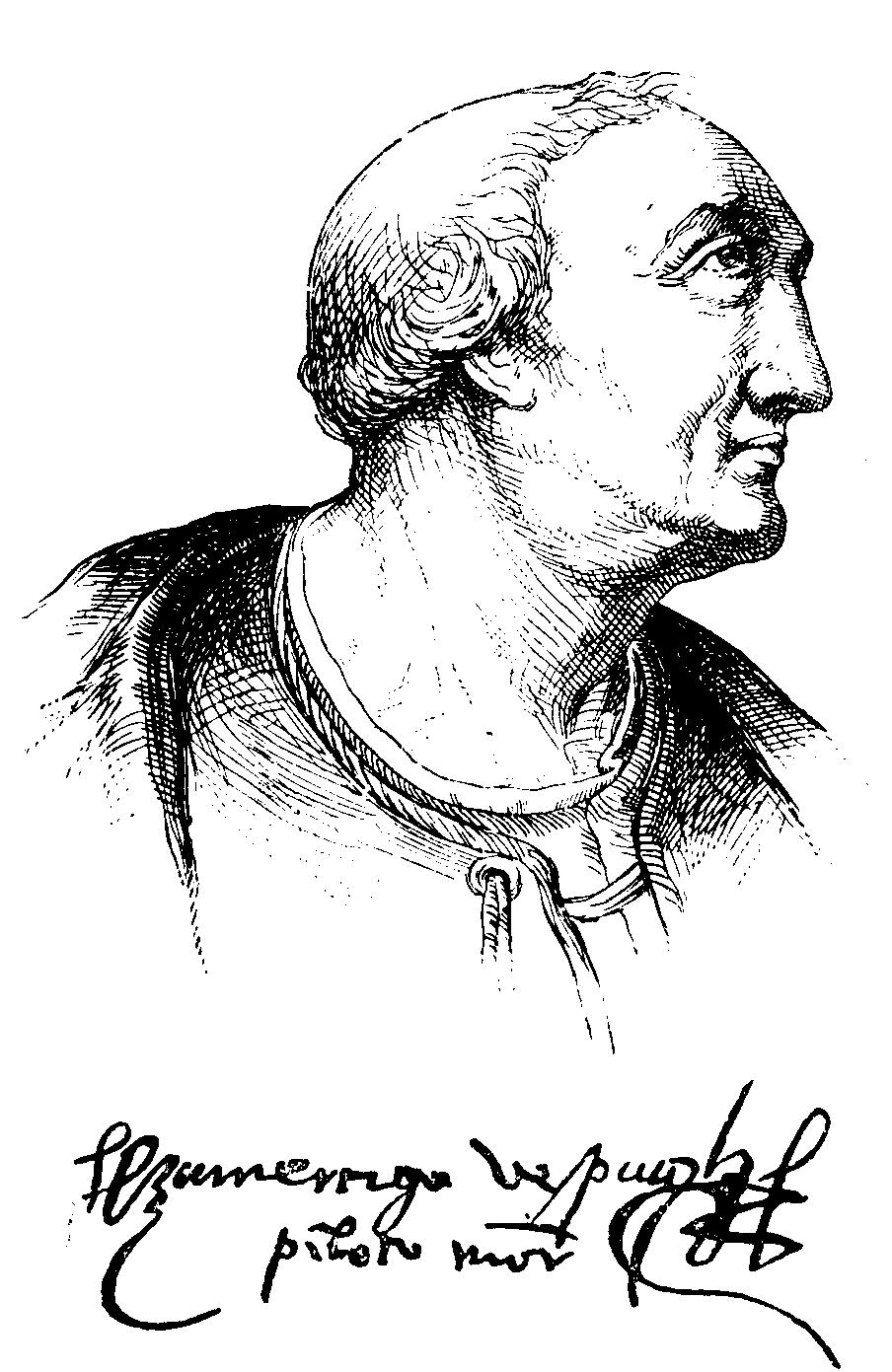
AMERIGO (or AMERICO) VESPUCCI (or VESPUCIO) (ves-puteh'-ee), Italian navigator, born in Florence, Italy, 9 March 1451; died in Seville, Spain, 22 February 1512. He was of a wealthy family of merchants, and received his education from his uncle, Giorgi Antonio Vespucci, a Dominican friar, a friend and colleague of Savonarola. He engaged in business, first in Florence and afterward in Seville, where he met Columbus, perhaps as early as 1493, and where in 1497 he equipped the fleet with which that navigator sailed on his third voyage. He had previously, in 1496, had charge of fitting out a fleet for the Spanish government. Amerigo sailed from Spaifi in 1499 in an expedition that visited the neighborhood of Cape Paria and several hundred miles of coast, and returned in June 1500. In May 1501, he entered the service of Emanuel, of Portugal, and participated in an expedition that visited the coast of Brazil in May 1503, he commanded a caravel in a squadron that sailed for the discovery of Malacca, but parted company from the rest, and finally made his way to the coast of Brazil, where he discovered the bay of All Saints, remained there two months, then ran 260 leagues farther south, where he built a fort, somewhere near Cape Frio, and, leaving a colony there, returned to Lisbon in June 1504. Early in 1505 he obtained from King Ferdinand of Spain letters of naturalization, and on 22 March 1508, was appointed pilot-major of the kingdom, an office that he held until his death, taking charge of the preparation of a general description of coasts and accounts of new discoveries, and also superintending the construction of charts and the examination of pilots. The controversy as to whether Vespucci took precedence both of the (Jabots and of Columbus in the discovery of the mainland of America has been for centuries a matter of dispute. None of the original letters of Amerigo bearing on the subject are extant, except in translations, and these differ greatly among themselves and contain inconsistencies of fact and date. It is not even known in what language the letters were written. Bandini published an account by Amerigo of his voyage of 1499, said to have been written 18 July 1500, in 1745. A letter of his to Lorenzo Piero de Medici, a cousin of Lorenzo the Magnificent, describing the voyage of 1501, was published in various editions, some in Latin, others in German, and in 1789 a new text, in Italian, was discovered by Bartolozzi. The Strasburg edition of 1505 bears the title " De Ora Antarctica." In 1507 a "Cosmographiac Introductio " was published at the little College of St. Dig in Lorraine, and to it was appended an account by Amerigo of his voyages, purporting to be addressed to Rene H., duke of Lorraine, here it is asserted that four voyages were made, the date of the first being fixed at May 1497. Amerigo would thus have reached the mainland a week or two earlier than Cabot, and about 14 months earlier than Columbus. It was also suggested in this book that Amerigo should give his name to the continent he had discovered. The best authorities now consider the evidence incontrovertible that this date of 1497 is incorrect, and doubt has thus been thrown upon the rest of Amerigo's narrative. Many with deliberate falsification have charged him, and most of his apologists have contented themselves with defending his character, rather than the truth of his narrative, ascribing the inconsistencies of the latter to the errors of translators and copyists. Santarem, in his "Researches," says he could find no mention at all of Vespucci in the royal archives of Portugal, nor in the diplomatic records, where all new discoveries were mentioned, and the fact that his reputed discovery of the mainland was not used as evidence by the Spanish government in an action at law in 1512, where it would have been in their favor, seems to show that it was not given credence at that day. The name of America, however, suggested by the "Cosmographiae Introductio," began soon to be generally used, and it was not until the publication of Schoner's " Opuscululn Geographicum" (1533) that doubt began to be thrown on its propriety. See " Life and Voyages of Americus Vespueius," by C. E. Lester (New York, 1846); Santarem's "Vespucius and his Voyages," translated by E. V. Childe (Boston, 1850): and Winsor's "Narrative and Critical History of America" (Boston, 1884).
Unauthorized Site:
This site and its contents are not affiliated, connected,
associated with or authorized by the individual, family,
friends, or trademarked entities utilizing any part or
the subject's entire name. Any official or affiliated
sites that are related to this subject will be hyper
linked below upon submission
and Evisum, Inc. review.
Please join us in our mission to incorporate The Congressional Evolution of the United States of America discovery-based curriculum into the classroom of every primary and secondary school in the United States of America by July 2, 2026, the nation’s 250th birthday. , the United States of America: We The
People. Click Here





+(ves-puteh'-ee)amerigo+(or&sa=Search&client=pub-6208259748185603&forid=1&ie=ISO-8859-1&oe=ISO-8859-1&safe=active&cof=GALT%3A%23008000%3BGL%3A1%3BDIV%3A%23336699%3BVLC%3A663399%3BAH%3Acenter%3BBGC%3AFFFFFF%3BLBGC%3AFFFFFF%3BALC%3A0000FF%3BLC%3A0000FF%3BT%3A000000%3BGFNT%3A0000FF%3BGIMP%3A0000FF%3BLH%3A77%3BLW%3A200%3BL%3Ahttp%3A%2F%2Fwww.evisum.com%2Fimages%2Flogo4.gif%3BS%3Ahttp%3A%2F%2Fwww.evisum.com%2F%3BLP%3A1%3BFORID%3A1%3B&hl=en)


