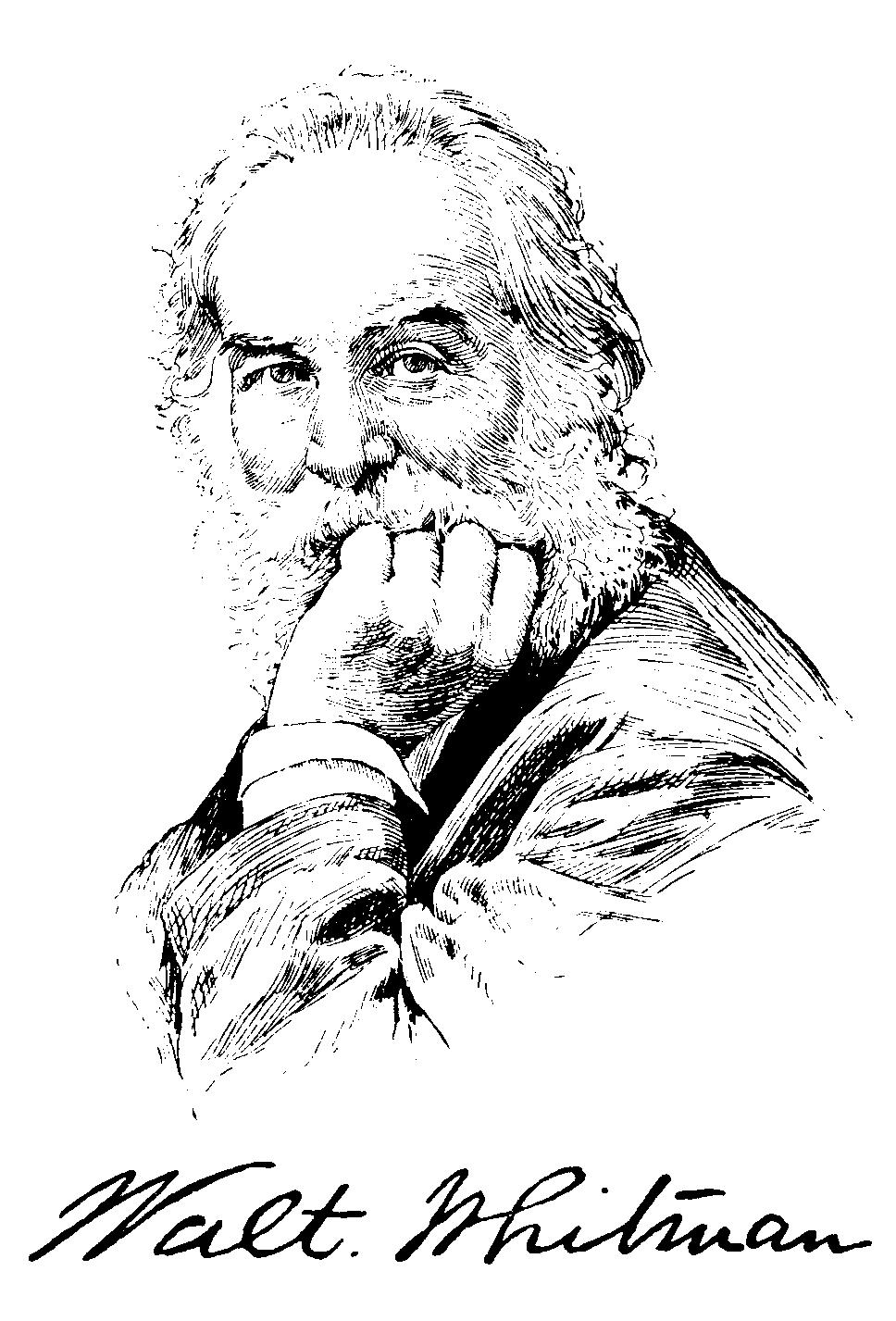
Appleton's Cyclopedia of American Biography, edited by James
Grant Wilson, John Fiske and Stanley L. Klos. Six volumes, New York: D. Appleton
and Company, 1887-1889 and 1999. Virtualology.com warns that these 19th Century
biographies contain errors and bias. We rely on volunteers to edit the historic
biographies on a continual basis. If you would like to edit this biographyplease
submit a rewritten biography in text form.
If acceptable, the new biography will be published above the 19th Century
Appleton's Cyclopedia Biography citing the volunteer editor
Virtual American Biographies
Over 30,000 personalities
with thousands of 19th Century illustrations, signatures, and exceptional life
stories. Virtualology.com
welcomes editing and additions to the
biographies. To become this site's editor or a contributor
Click Here
or e-mail Virtualology here.
WHITMAN, Walt, or Walter, poet, born in West Hills, Long Island, New York, 31 May, 1819. He was educated in the public schools of Brooklyn and New York city, and learned printing, working at that trade in summer and teaching in winter. Subsequently he also acquired skill as a carpenter. For brief periods he edited newspapers in New Orleans and in Huntington, L.I. In 1847-'8 he made long pedestrian tours through the United States, generally following the courses of the great western rivers, and also extended his journey through Canada. His chief work, "Leaves of Grass" (New York, 1855), is a series of poems dealing with moral, social, and political problems, and more especially with the interests involved in 19th century American life and progress. In it he made a new and abrupt departure as to form, casting his thoughts in a mould the style of which is something between rhythmical prose and verse, altogether discarding rhythm and regular metre, but uttering musical thoughts in an unconventional way which is entirely his own. Expecting the opposition and abuse with which his volume was assailed, he speaks of it as a sortie on common literary use and wont, on both spirit and form, adding that a century may elapse before its triumph or failure can be assured. For thirty years Whitman has been correcting and adding to this work, and he says that he looks upon "Leaves of Grass" " now finished to the end of its opportunities and powers, as my definitive carte visite to the coming generations of the New World, if I may assume to say so." In the war Whitman's brother was wounded on the battle-field, which led to the poet's at once hastening to join him in the camp, where he afterward remained as a volunteer army nurse at Washington and in Virginia in 1862-'5. His experiences during this service are vividly recorded in " Drum-Taps" (1865) and "Memoranda during the War" (1867). His fatigue and night-watching in 1864 brought on a serious illness, from which he has never entirely recovered. In 1870 he published a volume of prose essays called "Democratic Vistas," a new edition of which has been issued by Walter Scott (London, 1888), with a preface written by Whitman in April of the same year. In this volume he explains that he uses the word "Democrat" in its widest sense as synonymous with the American form of government. From 1865 till 1874 Whitman held a government clerkship in Washington. In February', 1873, the lingering effects of his nursing fatigues and illness during the war culminated in a severe paralytic attack. He left Washington for Camden, New Jersey, and was recovering when in May of the same year his mother died somewhat suddenly in his presence. This shock caused a relapse. He abandoned Washington and has continued to reside at Camden. Mr. Whitman has been called "the good gray poet." His admirers, especially in England, have been extravagant in their praise of his works, comparing him with the best of the classic writers, and in this country Ralph Waldo Emerson said on the appearance of "Leaves of Grass ": "I find it the most extraordinary piece of wit and wisdom that America has yet contributed I find incomparable things incomparably said." On the other hand, the peculiar form of his writings prevents their popularity, and their substance has been widely regarded as of no value. "Leaves of Grass" has even been condemned for indecency on account of its outspokenness, and when a complete edition of the work was published (Boston, 1881) the Massachusetts authorities objected to its sale in that state on the ground of immorality. Besides the works already mentioned, Whitman has published "Passage to India" (1870) ; "After All, not to Create Only" (1871); "As Strong as a Bird on Pinions Free" (1872): "Two Rivulets," including " Democratic Vistas" and " Passage to India" (1873) ; "Specimen Days and Collect " (1883) ; "November Boughs" (1885) ; and '" Sands at Seventy" (1888). A selection of his poems, by William M. Rossetti, was published (London, 1868). Besides the complete edition of "Leaves of Grass" that has been mentioned, another, edited by Professor Edward Dow-den, has since been issued (Glasgow, Scotland). A popular selection, with introduction by Ernest Rhys, was published by Walter Scott (London, 1886). See " The Good Gray Poet, a Vindication," by William D. O'Connor (New York, 1866), and "Notes on Walt Whitman as Poet and Person," by John Burroughs (1866).
Unauthorized Site:
This site and its contents are not affiliated, connected,
associated with or authorized by the individual, family,
friends, or trademarked entities utilizing any part or
the subject's entire name. Any official or affiliated
sites that are related to this subject will be hyper
linked below upon submission
and Evisum, Inc. review.
Please join us in our mission to incorporate The Congressional Evolution of the United States of America discovery-based curriculum into the classroom of every primary and secondary school in the United States of America by July 2, 2026, the nation’s 250th birthday. , the United States of America: We The
People. Click Here