Appleton's Cyclopedia of American Biography, edited by James
Grant Wilson, John Fiske and Stanley L. Klos. Six volumes, New York: D. Appleton
and Company, 1887-1889 and 1999. Virtualology.com warns that these 19th Century
biographies contain errors and bias. We rely on volunteers to edit the historic
biographies on a continual basis. If you would like to edit this biographyplease
submit a rewritten biography in text form.
If acceptable, the new biography will be published above the 19th Century
Appleton's Cyclopedia Biography citing the volunteer editor
Virtual American Biographies
Over 30,000 personalities
with thousands of 19th Century illustrations, signatures, and exceptional life
stories. Virtualology.com
welcomes editing and additions to the
biographies. To become this site's editor or a contributor
Click Here
or e-mail Virtualology here.
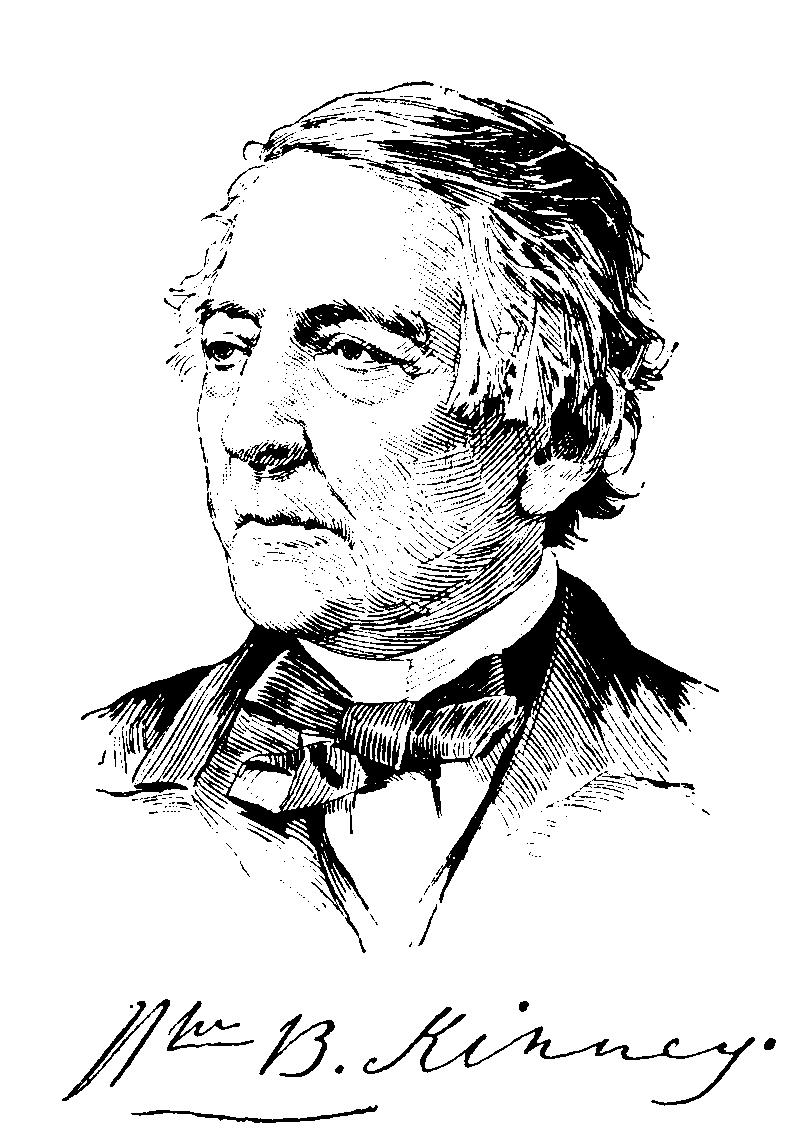
KINNEY, William Burnet, journalist, born in Speedwell, Morris County, New Jersey, 4 September, 1799; died in New York city, 21 October, 1880. His grandfather, Sir Thomas Kinney, came to this country before the Revolution to explore the mineral resources of New Jersey. William Burnet received a good education, and subsequently studied law under Joseph C. Hornblower. In 1820 he began the life of an editor in Newark, New Jersey, which, with one or two interruptions, he continued to lead until his appointment, in 1851, as United States minister to Sardinia. Prior to this event he had been conspicuous in various public capacities, and among them as a delegate, in 1844, to the Baltimore Whig convention, where he was largely instrumental in securing the nomination of his friend, Theodore Frelinghuysen, for the vice presidency, with Henry Clay. While minister at Turin he discussed with Count Cavour and other eminent men of the kingdom of Sardinia the movement for the unification of Italy. He rendered also, at the same time, important services to Great Britain, for which he received an acknowledgment in a special despatch from Lord Palmerston. When the United States government offered to transport Kossuth to the United States in a national ship, detached from the Mediterranean squadron, Mr. Kinney made himself acquainted with the aims and purposes of the Hungarian exile, and gave prompt instructions to the commander, and information to his own government, of the objects of the fugitive. Daniel Webster, who was at that time secretary of state, thwarted Kossuth's philanthropic but impracticable efforts to enlist the United States in a foreign complication. On the expiration of his term of office he removed from Turin to Florence, where he devoted much of his time to making additions to the new information, which his post had enabled him to acquire, relative to the Medici family, with a view to producing a historical work, which promised to be of great importance, but he did not live to accomplish it.--His wife, Elizabeth Clementine, poet, born in New York city, 18 December, 1810, is the daughter of David L. Dodge, of New York city. Her first husband was Edmund B. Stedman, a merchant of Hartford, Connecticut She has contributed to periodical literature, and has published "Felicita, a Metrical Romance" (New York, 1855); " Poems" (1867); and "Bianca Cappello," a tragedy founded on Italian history, and written during her residence abroad (1873).
Unauthorized Site:
This site and its contents are not affiliated, connected,
associated with or authorized by the individual, family,
friends, or trademarked entities utilizing any part or
the subject's entire name. Any official or affiliated
sites that are related to this subject will be hyper
linked below upon submission
and Evisum, Inc. review.
Please join us in our mission to incorporate The Congressional Evolution of the United States of America discovery-based curriculum into the classroom of every primary and secondary school in the United States of America by July 2, 2026, the nation’s 250th birthday. , the United States of America: We The
People. Click Here