Appleton's Cyclopedia of American Biography, edited by James
Grant Wilson, John Fiske and Stanley L. Klos. Six volumes, New York: D. Appleton
and Company, 1887-1889 and 1999. Virtualology.com warns that these 19th Century
biographies contain errors and bias. We rely on volunteers to edit the historic
biographies on a continual basis. If you would like to edit this biographyplease
submit a rewritten biography in text form.
If acceptable, the new biography will be published above the 19th Century
Appleton's Cyclopedia Biography citing the volunteer editor
Virtual American Biographies
Over 30,000 personalities
with thousands of 19th Century illustrations, signatures, and exceptional life
stories. Virtualology.com
welcomes editing and additions to the
biographies. To become this site's editor or a contributor
Click Here
or e-mail Virtualology here.
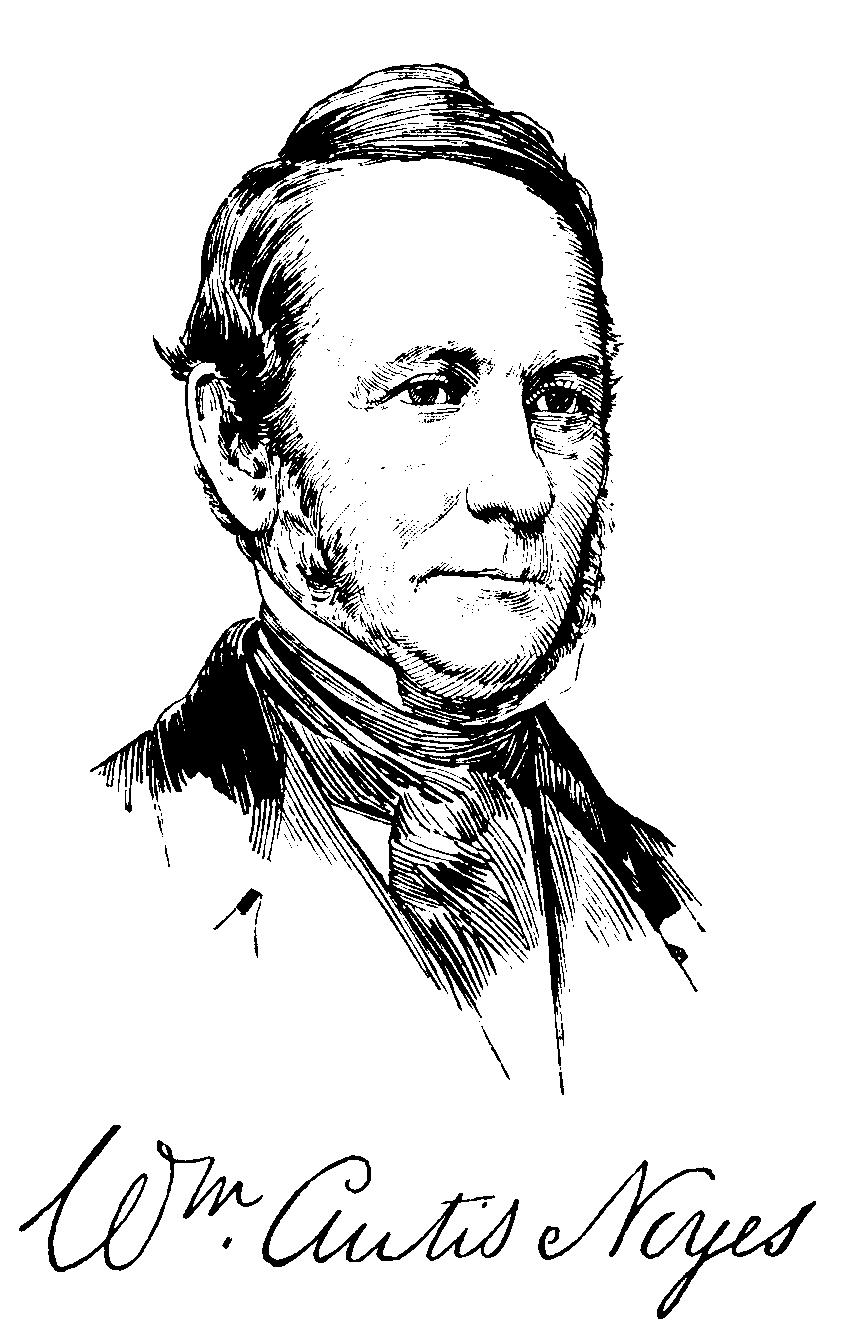
NOYES, William Curtis, jurist, born in Schodack, Rensselaer County, New York, 19 August, 1805; died in New York city, 25 December, 1864. He began the study of law, when he was fourteen years of age, in the office of Samuel B. Ludlow, of Albany. His parents soon afterward removed to Oneida county, where he entered the office of Henry R. Storrs, and in 1827 completed his studies and was admitted to the bar. While yet under the age of thirty he was appointed district attorney of Oneida county, and soon rose to the front rank of the profession there. Later he removed to New York city. He was never a politician, but took a deep interest in public affairs, being a man of extensive reading and learning. His conversational powers were of the highest order. His appreciation of beauty, art, and literature was cultivated and pure, and he was surrounded by one of the finest law libraries in this country, which, upon his death, he gave to Hamilton college He became one of the most powerful advocates at the New York bar. In 1857 he was appointed by the legislature a commissioner with Alexander W. Bradford and David Dudley Field to codify the laws of the state, and he was engaged in this work up to the time of his death. In the autumn of that year he was nominated as a Republican for attorney-general of the state, but was defeated by Lyman Tremain. In 1861 he was appointed by the legislature a commissioner to t conference, where he steadily labored to preserve the integrity of the republic, and at the same time maintain the honor of the loyal states. When, in the winter of the same year, the legisla-tare had to elect a United States senator, he was one of the chief candidates for the nomination. Mr. Noyes was retained in some of the most celebrated cases of his day. His masterly analysis of moral insanity on the trial of Huntington, his argument in the court of appeals in the New Haven railroad case, his elaborate speech in the suit of the Delaware and Hudson Canal company vs. The Pennsylvania Coal company, and his numerous arguments in some of the most important will cases, were marked by learning, eloquence, and close logic. He was a firm advocate of temperance, and devoted much time to addresses on this subject. His talents were always enlisted on the side of the people among whom he lived, and more than once fraudulent judgments against the city were vacated through his clear demonstration of their fallacy. As an equity lawyer he was without a parallel, and in cross-examination he had no equal. Few witnesses that went on the stand before him with the determination to commit perjury ever left it without being exposed. In 1856 he delivered an address before the graduating class of the law department of Hamilton college, and, although he never had received a collegiate education, yet that institution conferred on him the degree of LL.D. True to his motto, that it was "better that a man's brain should wear out than rust out," he continued to the last in the practice of his profession. His death was the result of apoplexy.
Unauthorized Site:
This site and its contents are not affiliated, connected,
associated with or authorized by the individual, family,
friends, or trademarked entities utilizing any part or
the subject's entire name. Any official or affiliated
sites that are related to this subject will be hyper
linked below upon submission
and Evisum, Inc. review.
Please join us in our mission to incorporate The Congressional Evolution of the United States of America discovery-based curriculum into the classroom of every primary and secondary school in the United States of America by July 2, 2026, the nation’s 250th birthday. , the United States of America: We The
People. Click Here