Appleton's Cyclopedia of American Biography, edited by James
Grant Wilson, John Fiske and Stanley L. Klos. Six volumes, New York: D. Appleton
and Company, 1887-1889 and 1999. Virtualology.com warns that these 19th Century
biographies contain errors and bias. We rely on volunteers to edit the historic
biographies on a continual basis. If you would like to edit this biographyplease
submit a rewritten biography in text form.
If acceptable, the new biography will be published above the 19th Century
Appleton's Cyclopedia Biography citing the volunteer editor
Virtual American Biographies
Over 30,000 personalities
with thousands of 19th Century illustrations, signatures, and exceptional life
stories. Virtualology.com
welcomes editing and additions to the
biographies. To become this site's editor or a contributor
Click Here
or e-mail Virtualology here.
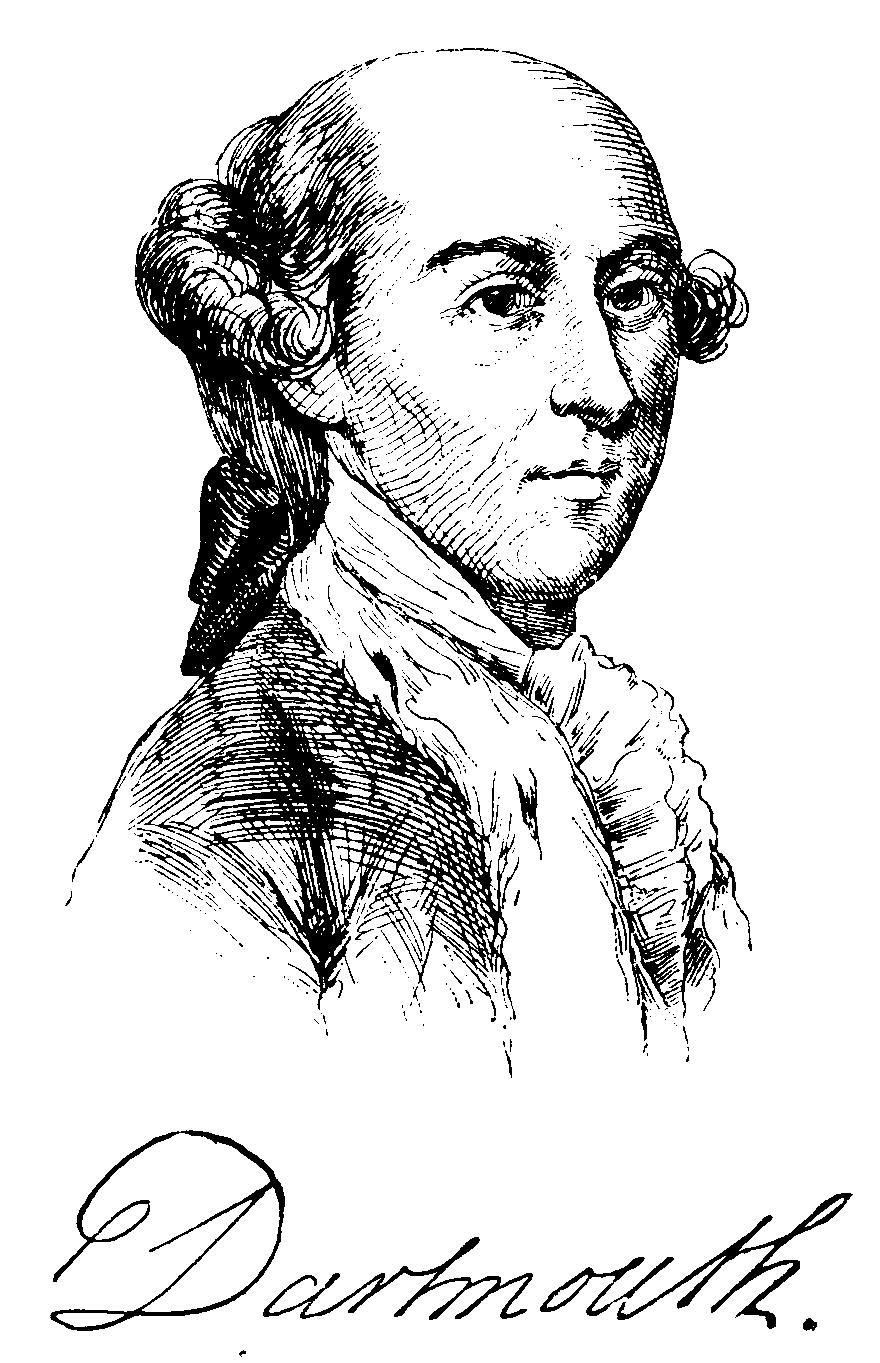
LEGGE, William, second Earl of Dartmouth, English statesman, born in England in 1731; died there in 1801. His grandfather, George, first Baron of Dartmouth, was master of the ordnance, and afterward admiral of the fleet, under James II., whose fortunes he followed in the revolution of 1688, and his father, William, was made an earl by Queen Anne, at whose death he was a lord-justice of Great Britain. The son succeeded to the title in 1750. He took much interest in education in the colonies, and was a subscriber to the fund that was collected in England by Sampson Occum, a young Mohican Indian, for the benefit of the indian charity school that had been planned by Occum, and partially endowed by Joshua Moor, in Lebanon, Connecticut (See WHEELOCK, ELEAZAR) Lord Dartmouth became president of the trustees of this fund, and when, in 1769, the institution was chartered as a college and removed to Hanover, New Hampshire, it was given the name of its patron, although, with his fellow trustees, he opposed the change. As a result of this opposition, the charity school obtained an independent charter, and remained distinct from the college till 1849. Lord Dartmouth was secretary of state for the colonies from 1770 till 1775.
Unauthorized Site:
This site and its contents are not affiliated, connected,
associated with or authorized by the individual, family,
friends, or trademarked entities utilizing any part or
the subject's entire name. Any official or affiliated
sites that are related to this subject will be hyper
linked below upon submission
and Evisum, Inc. review.
Please join us in our mission to incorporate The Congressional Evolution of the United States of America discovery-based curriculum into the classroom of every primary and secondary school in the United States of America by July 2, 2026, the nation’s 250th birthday. , the United States of America: We The
People. Click Here