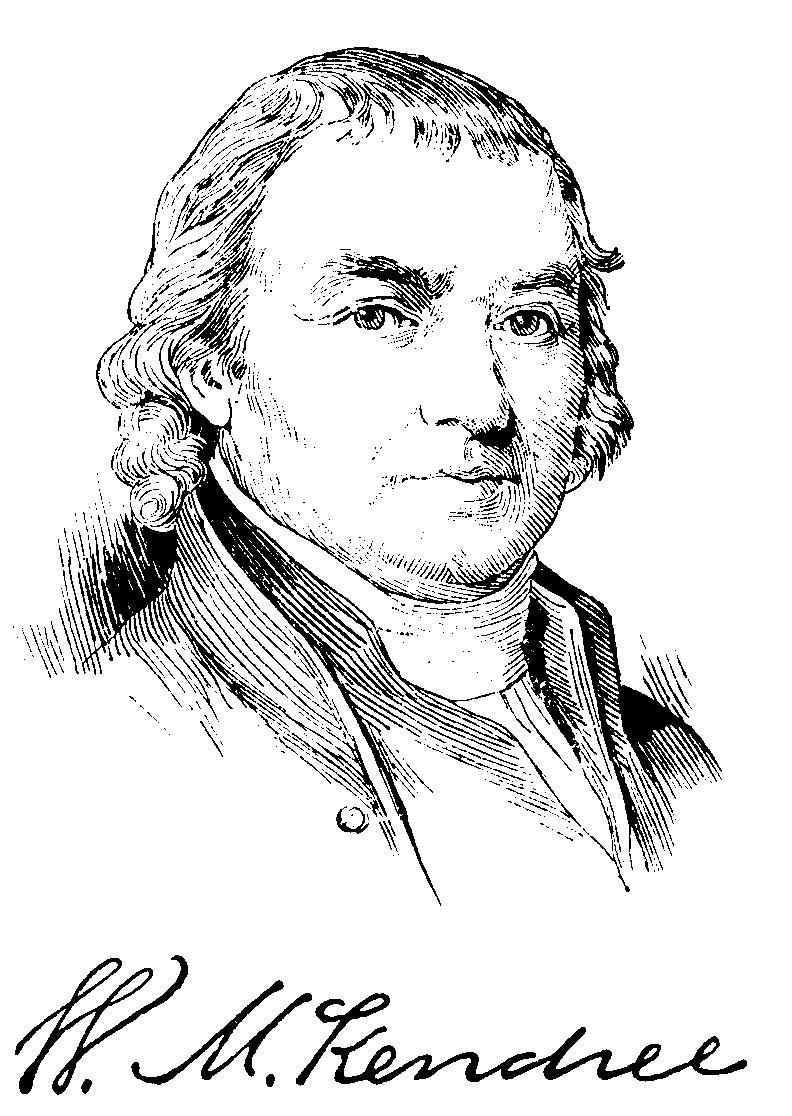
Appleton's Cyclopedia of American Biography, edited by James
Grant Wilson, John Fiske and Stanley L. Klos. Six volumes, New York: D. Appleton
and Company, 1887-1889 and 1999. Virtualology.com warns that these 19th Century
biographies contain errors and bias. We rely on volunteers to edit the historic
biographies on a continual basis. If you would like to edit this biographyplease
submit a rewritten biography in text form.
If acceptable, the new biography will be published above the 19th Century
Appleton's Cyclopedia Biography citing the volunteer editor
Virtual American Biographies
Over 30,000 personalities
with thousands of 19th Century illustrations, signatures, and exceptional life
stories. Virtualology.com
welcomes editing and additions to the
biographies. To become this site's editor or a contributor
Click Here
or e-mail Virtualology here.
McKENDREE, William, M. E. bishop, born in King William county, Virginia, 6 July, 1757" died in Sumner county, Tennessee, 5 March, 1835. Shortly after his birth the family residence was changed to Greenville county. His father was a planter, and the son was trained for the same calling. In 1810 the family removed to Sumner county, Tennessee. At the beginning of the Revolution, William, then twenty years of age, joined a company of volunteers, was for some time an adjutant in the service, and was at Yorktown at the surrender of Cornwallis. At the end of the war he returned to private life, and would never accept a pension. His opportunities for gaining an education were very small, yet after leaving the army he served for a time as a school-teacher, and in his public life, in both his preaching and writings, ha displayed a good understanding of the English language, as well as much sound learning and breadth of thought. Before leaving home he had become connected with the Methodist church, but it was not till 1787, when he was residing in Brunswick county, Virginia, that he became thoroughly awakened in the religious life. Soon after this he was licensed to preach, and in 1788 Bishop Asbury appointed him as junior preacher to Mecklenburg circuit. After this he served successively for several years upon neighboring circuits, and in 1793 he was sent to South Carolina, but returned the next year, and for three years had charge of a vast district that extended from Chesapeake bay to the Blue Ridge and Alleghany mountains. In 1798 his appointment was in the Baltimore conference, and in 1800 he went with Bishop Asbury and Bishop Whatcoat to the western conference, which met that year at Bethel, Kentucky He was appointed to superintend a district that embraced a large part of the partially settled territory beyond the Alleghany mountains. In this pioneer work he passed the next eight years--a kind of evangelistic Daniel Boone, but without any of his savagery--with a yearly pittance for his support of from twenty to less than fifty dollars. In the wonderful revival of those years, in all that region, out of which grew the Cumberland Presbyterian church, he was at once an inspiring and directing spirit, and it is claimed that ha, more than any other man, saved that great work from degenerating into a wild and ruinous fanaticism. Some have believed that his ministry during these years contributed largely to save the great west from falling into a condition of godless barbarism. He continued to preside over this work till the spring of 1808, when he came to the general conference at Baltimore, and was there elected and ordained bishop. His first episcopal tour of 1,500 miles extended through Virginia, Tennessee, Missouri, and Illinois. In October he was at the conference in middle Tennessee, and by his wonderful preaching and his administrative ability inspired both the zeal and the confidence of the preachers. He continued to travel at large through the whole country, sometimes prostrated by rheumatism and fevers, but presently again in the saddle, pushing forward to new labors; and at the general conference of 1816 he found himself left, by the death of Bishop Asbury, the only bishop of his church. Two additional bishops were then chosen, and so the work proceeded, with a less severe strain upon himself. He continued to labor till 1835, when his health failed utterly. He was never married, never received a collegiate diploma, nor left even a brief record of his eventful life. See his "Life and Times," by Bishop Robert Paine (2 vols., 1859).
Unauthorized Site:
This site and its contents are not affiliated, connected,
associated with or authorized by the individual, family,
friends, or trademarked entities utilizing any part or
the subject's entire name. Any official or affiliated
sites that are related to this subject will be hyper
linked below upon submission
and Evisum, Inc. review.
Please join us in our mission to incorporate The Congressional Evolution of the United States of America discovery-based curriculum into the classroom of every primary and secondary school in the United States of America by July 2, 2026, the nation’s 250th birthday. , the United States of America: We The
People. Click Here