Appleton's Cyclopedia of American Biography, edited by James
Grant Wilson, John Fiske and Stanley L. Klos. Six volumes, New York: D. Appleton
and Company, 1887-1889 and 1999. Virtualology.com warns that these 19th Century
biographies contain errors and bias. We rely on volunteers to edit the historic
biographies on a continual basis. If you would like to edit this biographyplease
submit a rewritten biography in text form.
If acceptable, the new biography will be published above the 19th Century
Appleton's Cyclopedia Biography citing the volunteer editor
Virtual American Biographies
Over 30,000 personalities
with thousands of 19th Century illustrations, signatures, and exceptional life
stories. Virtualology.com
welcomes editing and additions to the
biographies. To become this site's editor or a contributor
Click Here
or e-mail Virtualology here.
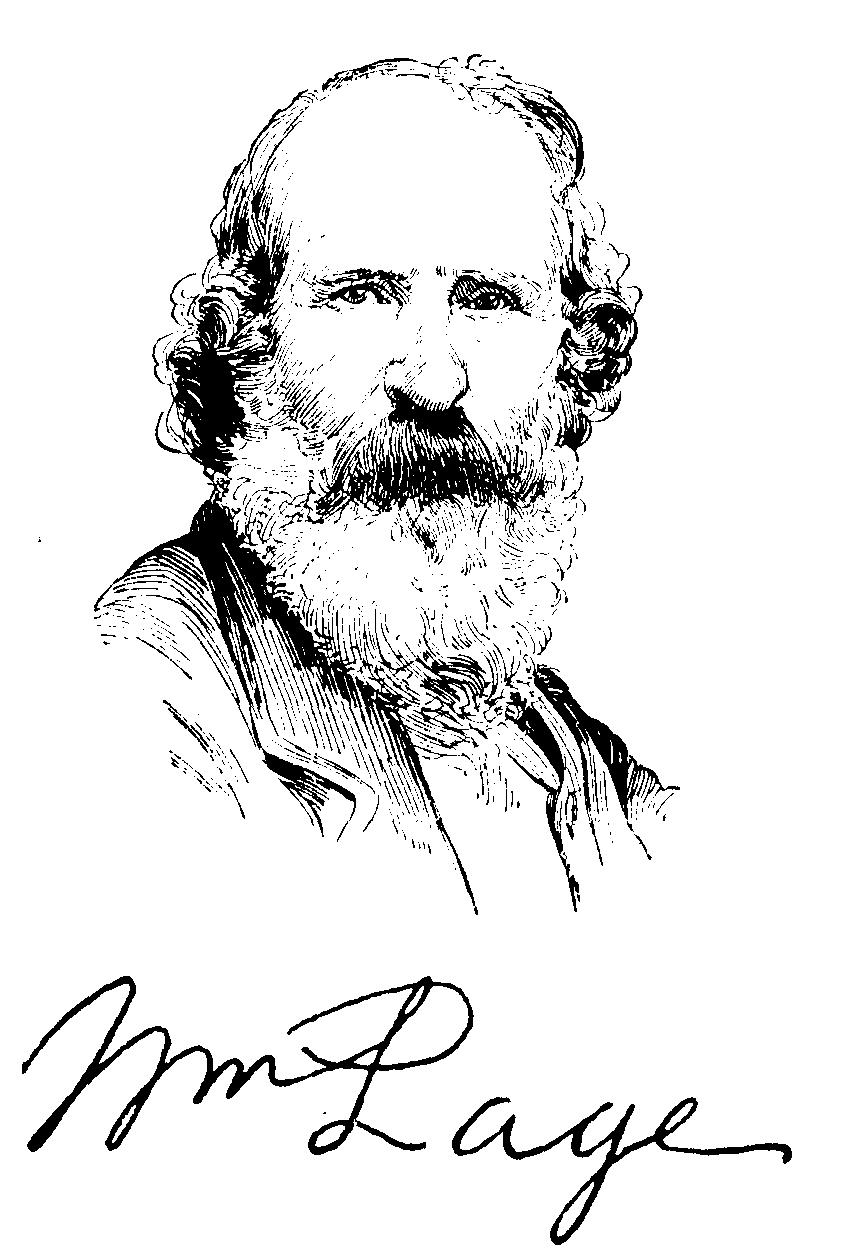
PAGE, William, artist, born in Albany, New York, 23 January, 1811: died in Tottenville, Staten island, New York, 1 October, 1885. He came to New York city with his parents at the age of nine, and in 1822 received a premium from the American institute for a drawing in India ink. At the age of fourteen he began to study law in the office of Frederick De Peyster, which he soon left to enter the studio of James Herring, and in less than a year he became a pupil of Samuel F. B. Morse, through whom he was also enrolled as a student in the Academy of design. His drawings in the antique class there won him the silver medal, but, uniting with the Presbyterian church, he determined to enter its ministry. For two years he studied theology at Andover and Amherst, at the end of which time he returned to art. After painting portraits in Albany for a year he went to New York, where he executed likenesses of William L. Marcy and John Quincy Adams. In 1836 he was elected a National academician, and he was president of the academy from 1871 till 1873. About 1844 he removed to Boston, but he returned in 1847 to New York, whence, after a stay of two years, he went to Europe, where he resided for eleven years in Florence and Rome, coming back to New York in 1860. While he was in Europe he painted the portraits of Robert Browning and his wife, and other well-known Englishmen and Americans, and produced also his "Venus," " Moses and Aaron on Mount Horeb," "Infant Bacchus," and " Flight into Egypt." He also took occasion to study the works of the great masters, notably Titian, whom he admired and emulated, and whose method of painting he strove to discover. The copies that he executed of Titian's paintings were so remarkable that one of them was seized by the Florentine authorities under the belief that it was the original. Page made many experiments in his study of art methods and color theories, and published a "New Geometrical Method of Measuring the Human Figure" (New York, 1860). His portraits, for which he was most noted, include those of Hiram Powers, painted in Florence about 1848, Henry Ward Beecher, Wendell Phillips, Charles P. Daly (1848), in New York Historical Society, James Russell Lowell, Josiah Quincy, Governor Reuben E. Fenton (1870), Charlotte. Cushman, General Grant (1880), Thomas Le Clear (1883), and Charles Stunner, which was left unfinished at the death of the statesman. His full-length painting of Admiral Farragut at the battle of Mobile Bay, of which a representation is given in the article FARRAOUT in this work, was purchased by a committee in 1871, and presented to the emperor of Russia. In 1870 Page exhibited a portrait head of Christ which attracted great attention and excited much controversy. His other paintings include, besides those already mentioned, " The Holy Family" (1837) ; " The Last Interview" (1838) ; "Head of Christ" (1870). "Ruth and Naomi "; and "Cupid" (1880). In 1874 Page made a second visit to Europe, in order to study the supposed death-mask of Shakespeare that is preserved in Germany, and on his return he executed a large bust and several portraits of the poet (1874-'8). He also possessed mechanical genius, and invented and patented various improvements in boats and guns.
Unauthorized Site:
This site and its contents are not affiliated, connected,
associated with or authorized by the individual, family,
friends, or trademarked entities utilizing any part or
the subject's entire name. Any official or affiliated
sites that are related to this subject will be hyper
linked below upon submission
and Evisum, Inc. review.
Please join us in our mission to incorporate The Congressional Evolution of the United States of America discovery-based curriculum into the classroom of every primary and secondary school in the United States of America by July 2, 2026, the nation’s 250th birthday. , the United States of America: We The
People. Click Here