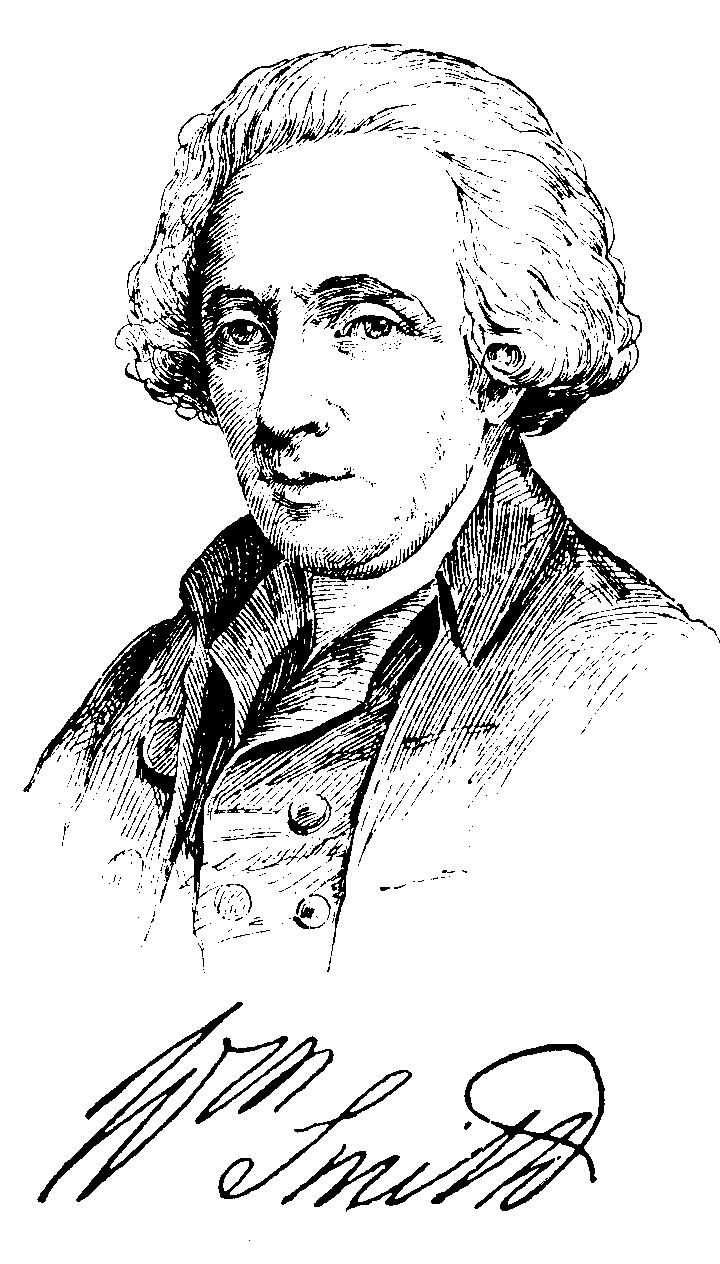
Appleton's Cyclopedia of American Biography, edited by James
Grant Wilson, John Fiske and Stanley L. Klos. Six volumes, New York: D. Appleton
and Company, 1887-1889 and 1999. Virtualology.com warns that these 19th Century
biographies contain errors and bias. We rely on volunteers to edit the historic
biographies on a continual basis. If you would like to edit this biographyplease
submit a rewritten biography in text form.
If acceptable, the new biography will be published above the 19th Century
Appleton's Cyclopedia Biography citing the volunteer editor
Virtual American Biographies
Over 30,000 personalities
with thousands of 19th Century illustrations, signatures, and exceptional life
stories. Virtualology.com
welcomes editing and additions to the
biographies. To become this site's editor or a contributor
Click Here
or e-mail Virtualology here.
SMITH, William, jurist, born in Newport-Pagnell, Buckinghamshire, England, 8 October, 1697 ; died in New York city, 22 November, 1769. His father, Thomas, a tallow-chandler, came to this country on account of his religious opinions in 1715, accompanied by his three sons. William was brought up as a Calvinist and a republican, was graduated at Yale in 1719, served as tutor there for five years, and in 1724 returned to New York city and was admitted to the bar. His eloquence and address soon brought him into notice, but in 1733 he was disbarred on account of his participation as counsel in a lawsuit against Governor William Cosby, where the principle that was involved was the right of the provincial council to provide a salary for one of their own number as acting governor during the interval between the death of one royal appointee and the arrival of another. He was restored in 1736, and his son, William Smith, the historian, recites as an instance of his eloquence that by his consummate art in telling the story of the crucifixion he succeeded in inducing the New York assembly to reject all the votes of the Jewish members, and so to establish the disputed election of his client. He also practised extensively in Connecticut, and in 1743-'4 was counsel for that colony in their case against the Mohegan Indians. He was appointed attorney-general and advocate-general by Governor George Clinton in 1751, succeeding Richard Bradley, and served one year, but was not confirmed by the royal authorities. He became a member of the governor's council in 1753, and held office till 1767, when he was succeeded by his son, William. In that capacity he attended the congress of the colonies that was held in Albany, New York, in June, 1754, and was the member frown New York of the committee to draft the plan of union, which he earnestly favored. In the same month he was a commissioner to fix the boundary-lines between New York and Massachusetts. He declined the office of chief justice of New York in 1760, became the associate justice of the same court in 1763, and held office until his death. The "New York Gazette" of the next week described him as "a gentleman of great erudition, the most eloquent speaker in the province, and a zealous and inflexible friend to the cause of religion and liberty."--His son, William, historian, born in New York city, 25 June, 1728; died in Quebec, Canada, 3 November, 1793, was graduated at Yale in 1745, studied law, was admitted to the bar of New York city, and soon acquired an extensive practice. He was an eloquent speaker, and many of his law opinions were collected and recorded by George Chalmers in his " Opinions on Interesting Subjects arising from American Independence" (1784). He became chief justice of the provinces of New York in 1763, succeeded his father as a member of the council in 1767, and held office nominally till 1782. During the Revolution he seems to have been at a loss as to which cause he should espouse. Governor Tryon wrote to Lord George Germaine, 24 September, 1776, that "Smith has withdrawn to his plantation up the North river, and has not been heard from for five months." It is probable he really joined the loyalists about 1778; previous to that year he had been confined on parole at Livingston Manor on the Hudson. But as he was in possession of his costly furniture, his servants and his family, and none of his property had been confiscated, it is probable that the Americans did not consider him wholly inimical to them. When he finally attached himself to the British cause the Whigs wrote scurrilous verses on his apostasy, and called him the weather-cock. The royalists welcomed him with honors, although his motives were strongly suspected. He went to England in 1783 with the British troops, became chief justice of Canada in 1786, and held office until his death. He was an upright and just judge, and, among the minor changes that he instituted in the courts, established the office of constable, whose duties before his administration had devolved upon the soldiers. He was intimate with many eminent English statesmen. He published, with William Livingston, "Revised Laws of New York, 1690-1762" (New York, 1762), and " History of the Province of New York from its Discovery in 1732," of which Chancellor James Kent says: " It is as dry as ordinary annals," and which John Neal calls " a dull, heavy, and circumstantial affair" (London, 1793; republished, with additions by William Smith, the third, 1814).--The second William's son, William, historian, born in New York, 7 February, 1769; died in Quebec, Canada, 17 December, 1847, accompanied his father to England in 1783, and returned with him to Canada in 1786, meanwhile attending a grammar-school near Kensington, England. He became successively clerk of the provincial parliament, master in chancery, and in 1814 secretary of state for the colonies and a member of the executive council. He published a "History of Canada from its Discovery" (2 vols., Quebec, 1815).--Another son of the first William, Joshua Hett, lawyer, born in New York city in 1736; died there in 1818, was educated for the bar, and practised with success. During the Revolution he was a Tory in politics, and in Benedict Arnold's treason in 1780 figured as his tool or accomplice. When Andre went up the Hudson river to meet Arnold, the two conspirators passed the night of 22 September at Smith's house. When the plot was complete Andre was ready to return, but, for some reason that Smith never explained, the latter refused to carry him on board the "Vulture," but accompanied him by land to a place of supposed safety, exchanging coats before they parted, for the better protection of Andre. Smith was subsequently tried by a military court for his connection with the affair, and was acquitted, but taken into custody by the civil authorities and committed to jail. After several months' imprisonment he escaped in woman's dress and made his way to New York, where he was protected by the loyal population. He went to England at the close of the war, but subsequently returned to the United States. He published " An Authentic Narrative of the Causes that led to the Death of Major Andre," of which Jared Sparks says : "The volume is not worthy of the least credit except when the statements are corroborated by other authorities" (London, 1808; New York, 1809).
Unauthorized Site:
This site and its contents are not affiliated, connected,
associated with or authorized by the individual, family,
friends, or trademarked entities utilizing any part or
the subject's entire name. Any official or affiliated
sites that are related to this subject will be hyper
linked below upon submission
and Evisum, Inc. review.
Please join us in our mission to incorporate The Congressional Evolution of the United States of America discovery-based curriculum into the classroom of every primary and secondary school in the United States of America by July 2, 2026, the nation’s 250th birthday. , the United States of America: We The
People. Click Here