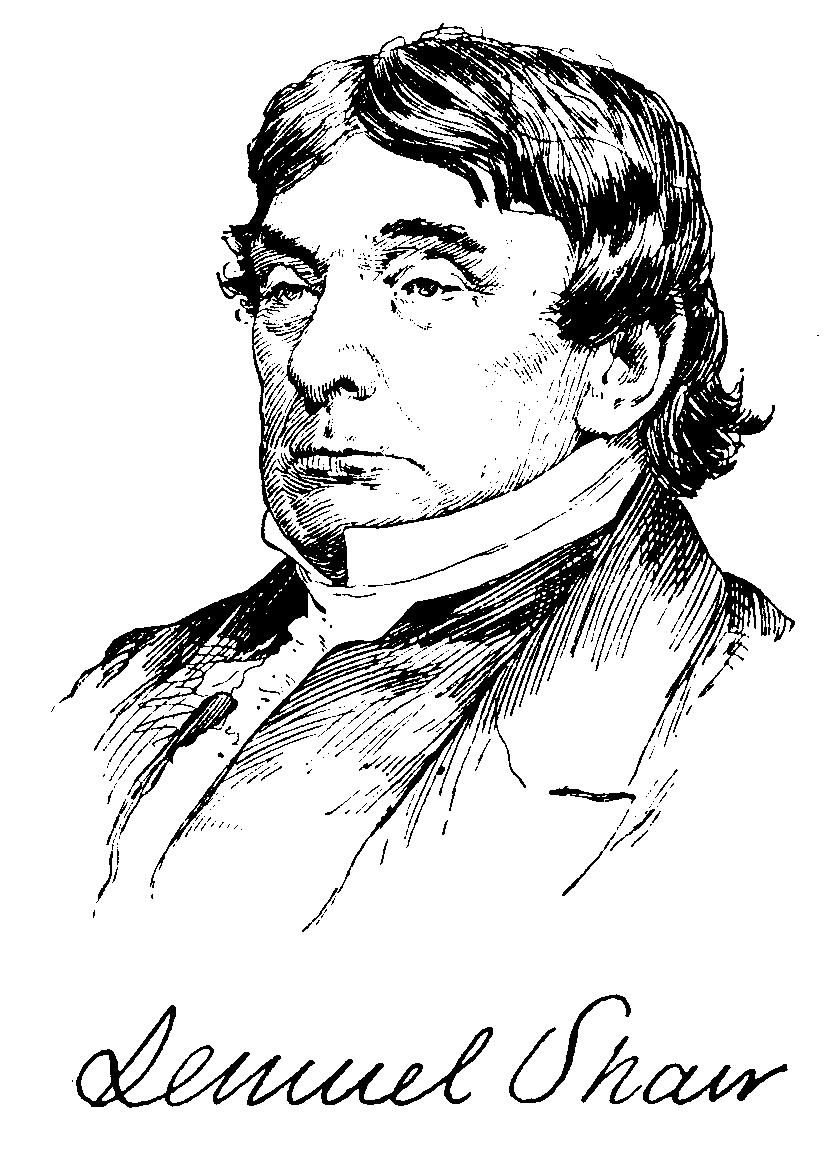
Appleton's Cyclopedia of American Biography, edited by James
Grant Wilson, John Fiske and Stanley L. Klos. Six volumes, New York: D. Appleton
and Company, 1887-1889 and 1999. Virtualology.com warns that these 19th Century
biographies contain errors and bias. We rely on volunteers to edit the historic
biographies on a continual basis. If you would like to edit this biographyplease
submit a rewritten biography in text form.
If acceptable, the new biography will be published above the 19th Century
Appleton's Cyclopedia Biography citing the volunteer editor
Virtual American Biographies
Over 30,000 personalities
with thousands of 19th Century illustrations, signatures, and exceptional life
stories. Virtualology.com
welcomes editing and additions to the
biographies. To become this site's editor or a contributor
Click Here
or e-mail Virtualology here.
SHAW, William Smith, lawyer, born in Haverhill, Massachusetts, 12 August, 1778; died in Boston, Massachusetts, 25 April, 1826. He was graduated at Harvard in 1798, became private secretary to his uncle, President John Adams, and at the close of the latter's administration began to study law in Boston with William Sullivan. He was admitted to the bar in April, 1804, and in the same year became treasurer of the Anthology society, tile nucleus of the Boston athenaeum, lie devoted much of his time to the collection of its library, and became known as "Athenaeum Shaw." He was the first to suggest making the library public, and connecting with it a reading-room. After the incorporation of the institution he was its secretary and librarian till 1823, and its secretary alone till 1824. At his decease he left it collections of coins, pamphlets, and books to the value of $10,000. For many years after 1806 he was clerk of the United States district court, and he took part in politics as secretary of the state Federalist committee. Mr. Shaw was a fellow of the American academy, an original member of the American antiquarian society, and an officer of the Linnaean society. Besides his connection with the "Monthly Anthology and Boston Review," the publication of the Anthology society, he was a pro-meter of the "North American Review." His per-trait, by Gilbert Stuart, was painted by order of the trustees of the Athemeum on his retirement from office. See "Memorials of William Smith Shaw," by Joseph B. Felt (Boston, 1852).--His cousin, Lemuel, jurist, born in Barnstable, Massachusetts, 9 January, 1781; died in Boston, Massachusetts, 30 March, 1861. His father, the Reverend Oakes Shaw, was pastor of the West Parish of Barnstable from 1760 till his death in 1807. The son was graduated at Harvard in 1800, and, after serving for a year as usher in the Franklin school in Boston, began the study of law in that city. He had also been an assistant editor of the Boston " Gazette," and in 1802 proposals were issued for the publication by subscription of his translation of a French work on the " Civil and Military Transactions of Bonaparte." He completed the translation, but it met with no financial support. He was admitted to the bar in 1804, began practice in Boston, and rose gradually to eminence in his profession. He was several times a member of the legislature between 1811 and 1819, and in 1820 a delegate to the State constitutional convention. In 1821-'2 and 1828-'9 he sat in the state senate. He draughted the charter of the city of Boston, and held various minor town offices, but never allowed these to interfere with his legal practice. In January, 1829, at a meeting that was held in opposition to the recently established tariff, he was the head of a committee to draught a memorial to congress. In 1830, on the death of Chief-Justice Isaac Parker, of the Massachusetts supreme court, Mr. Shaw was appointed his successor, though he had never held any judicial office. He declined peremptorily at first, but finally accepted. He took his seat in September, 1830, and held it till his resignation, 31 August, 1860. During this period he gained a high reputation for his judicial ability, and he is regarded as one of the foremost jurists that New England has produced. Few men have contributed more to the growth of the law as a progressive science. Among other noted cases he presided at the trial of the convent rioters in 1834, and at that of Professor John W. Webster for the murder of Dr. George Parkman. His charge to the jury in the latter case was widely condemned as harsh, but public opinion generally sustained him. In 1853 Judge Shaw visited England, where he was cordially received by members of the bar. He was an overseer of Harvard for twenty-two years, and for twenty-seven years one of its corporation, and he held membership in many learned societies. His reported decisions fill a large part of fifty volumes, and include many in novel and complicated cases. Among his published addresses are a "Fourth-of-July Oration "(1815) ;" Inaugural Address" (1830); and "Address at the Opening of tile New Court-House, Worcester" (1845).
Unauthorized Site:
This site and its contents are not affiliated, connected,
associated with or authorized by the individual, family,
friends, or trademarked entities utilizing any part or
the subject's entire name. Any official or affiliated
sites that are related to this subject will be hyper
linked below upon submission
and Evisum, Inc. review.
Please join us in our mission to incorporate The Congressional Evolution of the United States of America discovery-based curriculum into the classroom of every primary and secondary school in the United States of America by July 2, 2026, the nation’s 250th birthday. , the United States of America: We The
People. Click Here