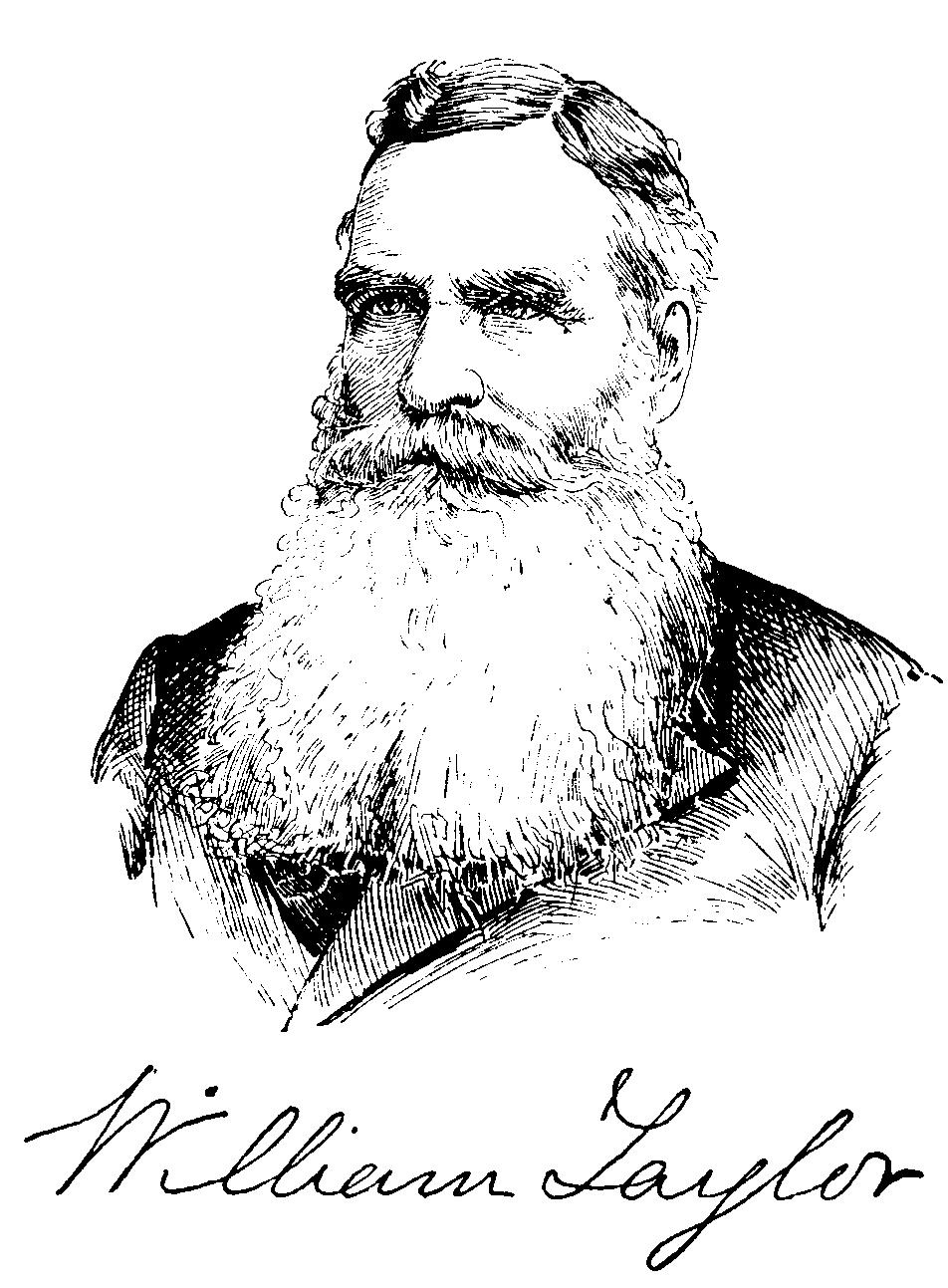
Appleton's Cyclopedia of American Biography, edited by James
Grant Wilson, John Fiske and Stanley L. Klos. Six volumes, New York: D. Appleton
and Company, 1887-1889 and 1999. Virtualology.com warns that these 19th Century
biographies contain errors and bias. We rely on volunteers to edit the historic
biographies on a continual basis. If you would like to edit this biographyplease
submit a rewritten biography in text form.
If acceptable, the new biography will be published above the 19th Century
Appleton's Cyclopedia Biography citing the volunteer editor
Virtual American Biographies
Over 30,000 personalities
with thousands of 19th Century illustrations, signatures, and exceptional life
stories. Virtualology.com
welcomes editing and additions to the
biographies. To become this site's editor or a contributor
Click Here
or e-mail Virtualology here.
TAYLOR, William, M. E. bishop, born in Rockbridge county, Virginia, 2 May, 1821. He was brought up as a farmer and tanner, became a Methodist preacher in 1842, was admitted on trial to the Baltimore conference in March, 1843, and was an itinerant till 1849, when he was sent to California as a missionary by the missionary society of the Methodist Episcopal church. After laboring there for seven years and for five years in Canada and the eastern states, he went to Europe in 1862, spending seven months in evangelistic work in the British islands, and then travelling over the continent and in Egypt and the Holy Land. For the next three years he conducted missionary services throughout Australia, Tasmania, and New Zealand. He afterward visited South Africa, and converted many of the Kaffirs to Christianity, going thence to Great Britain, where he conducted special services for about a year. He next made the tour of the Methodist missions in the West Indies, visited Australia a second time, and then spent some time in Ceylon, crossing over in 1872 to India, where within four years he succeeded in establishing self-supporting churches in Bombay, Poonah, Jubbulpore, Agra, Calcutta, Madras, Bangalore, Secunderabad, and elsewhere. As a result of his labors the South India conference and the Madras conference have been organized. He devoted himself afterward to educational and evangelistic work in Central America, and in Brazil, Chili, and Peru, and there also he founded independent mission churches. These self-supporting missions, which he began to establish in 1878, now occupy as centres Aspinwall, Callao, Iquique, Coquimbo, Santiago, Concepcion, Pernambuco, and Para. On 22 May, 1884, he was elevated to the episcopal office under the title of missionary bishop in Africa. Going to Central Africa, he established a chain of thirty-six mission stations on the Congo, extending 1,200 miles and 390 miles along the west coast, and employing seventy missionaries, who are supported by voluntary contributions of American Methodists until self-support can be developed from school-farms. In 1888 Bishop Taylor revisited the United States on the occasion of the general conference held in New York in May. He has published "Seven Years' Street Preaching in San Francisco" (New York, 1856; London, 1863); "Address to Young America, and a Word to the Old Folks" (1857); "California Life Illustrated" (New York, 1858; London, 1863) ; "The Model Preacher" (Cincinnati, 1860; London, 1865) ; "Reconciliation, or How to be Saved" (1867) ; "Infancy and Manhood of Christian Life" (1867); "The Election of Grace "(Cincinnati, 1868); "Christian Adventures in South Africa" (1867); " Four Years' Campaign in India" (1875); " Our South American Cousins" (1878) ; "Letters to a Quaker Friend on Baptism" (1880); "Ten Years of Self-Supporting Missions in India "(1882) ; and" Pauline Methods of Missionary Work" (1889).
Unauthorized Site:
This site and its contents are not affiliated, connected,
associated with or authorized by the individual, family,
friends, or trademarked entities utilizing any part or
the subject's entire name. Any official or affiliated
sites that are related to this subject will be hyper
linked below upon submission
and Evisum, Inc. review.
Please join us in our mission to incorporate The Congressional Evolution of the United States of America discovery-based curriculum into the classroom of every primary and secondary school in the United States of America by July 2, 2026, the nation’s 250th birthday. , the United States of America: We The
People. Click Here