Appleton's Cyclopedia of American Biography, edited by James
Grant Wilson, John Fiske and Stanley L. Klos. Six volumes, New York: D. Appleton
and Company, 1887-1889 and 1999. Virtualology.com warns that these 19th Century
biographies contain errors and bias. We rely on volunteers to edit the historic
biographies on a continual basis. If you would like to edit this biographyplease
submit a rewritten biography in text form.
If acceptable, the new biography will be published above the 19th Century
Appleton's Cyclopedia Biography citing the volunteer editor
Virtual American Biographies
Over 30,000 personalities
with thousands of 19th Century illustrations, signatures, and exceptional life
stories. Virtualology.com
welcomes editing and additions to the
biographies. To become this site's editor or a contributor
Click Here
or e-mail Virtualology here.
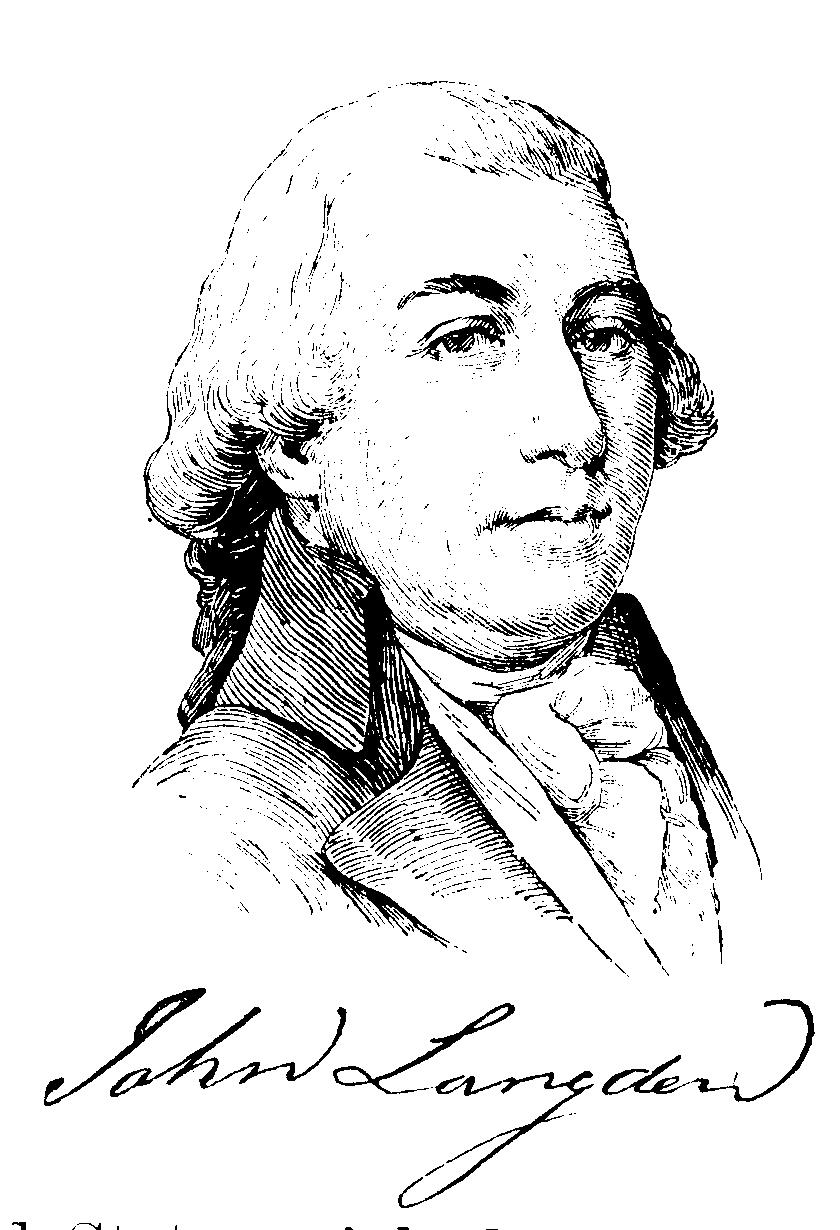
LANGDON, Woodbury, statesman, born in Portsmouth, New Hampshire, in 1739; died there, 13 January, 1805. He received a public school education, engaged in mercantile pursuits, and was active in pre-Revolutionary movements. He was a delegate from New Hampshire to the Continental congress of 1779-'80, was a member of the executive council in 1781-'4, and a judge of the supreme court of New Hampshire in 1782, and subsequently from 1786 till 1790. --His brother, John, statesman, born in Portsmouth, New Hampshire, 25 June, 1741; died there, 18 September, 1819, after receiving a common school education entered a .counting-house and became a successful merchant. in 1774, with John Sullivan and others, he participated in the removal of the armament and military stores from Fort William and Mary in Portsmouth harbor. He was elected a delegate to the Continental congress in 1775, but resigned in June, 1776, to become navy agent. In 1777, while he was Speaker of the New Hampshire assembly, when means were wanted to support a regiment. Langdon gave all his money, pledged his plate, and subscribed the proceeds of 70 hogsheads of tobacco for the purpose of equipping the brigade with which General John Stark subsequently defeated the Hessians at Bennington. Langdon participated in this battle, and was in command of a volunteer company at Saratoga, and in Rhode Island. In 1779 he was continental agent in New Hampshire, and president of the State convention. He was again a delegate to congress in 1783, was repeatedly a member of the legislature and its speaker, and in 1787 a delegate to the convention that framed the constitution of the United States. In March, 1788, he became governor of New Hampshire, and in 1789 he was elected United States senator, holding office till 1801, and was chosen president of the senate in order that the electoral votes for president of the United States might be counted. A president of the senate had therefore a legal existence before there was either a president or a vice president of the United States. He was a Republican in politics and acted with Jefferson, who, on assuming office in 1801, offered him the post of secretary of the navy, which he declined. From 1805 till 1812, with [he exception of two years, he was governor of New Hampshire, and in 1812 the Republican congressional caucus offered him the nomination for the office of vice president of the United States, which he declined on the score of age and infirmities, passing the remainder of his life in retirement.
Unauthorized Site:
This site and its contents are not affiliated, connected,
associated with or authorized by the individual, family,
friends, or trademarked entities utilizing any part or
the subject's entire name. Any official or affiliated
sites that are related to this subject will be hyper
linked below upon submission
and Evisum, Inc. review.
Please join us in our mission to incorporate The Congressional Evolution of the United States of America discovery-based curriculum into the classroom of every primary and secondary school in the United States of America by July 2, 2026, the nation’s 250th birthday. , the United States of America: We The
People. Click Here