Appleton's Cyclopedia of American Biography, edited by James
Grant Wilson, John Fiske and Stanley L. Klos. Six volumes, New York: D. Appleton
and Company, 1887-1889 and 1999. Virtualology.com warns that these 19th Century
biographies contain errors and bias. We rely on volunteers to edit the historic
biographies on a continual basis. If you would like to edit this biographyplease
submit a rewritten biography in text form.
If acceptable, the new biography will be published above the 19th Century
Appleton's Cyclopedia Biography citing the volunteer editor
Virtual American Biographies
Over 30,000 personalities
with thousands of 19th Century illustrations, signatures, and exceptional life
stories. Virtualology.com
welcomes editing and additions to the
biographies. To become this site's editor or a contributor
Click Here
or e-mail Virtualology here.
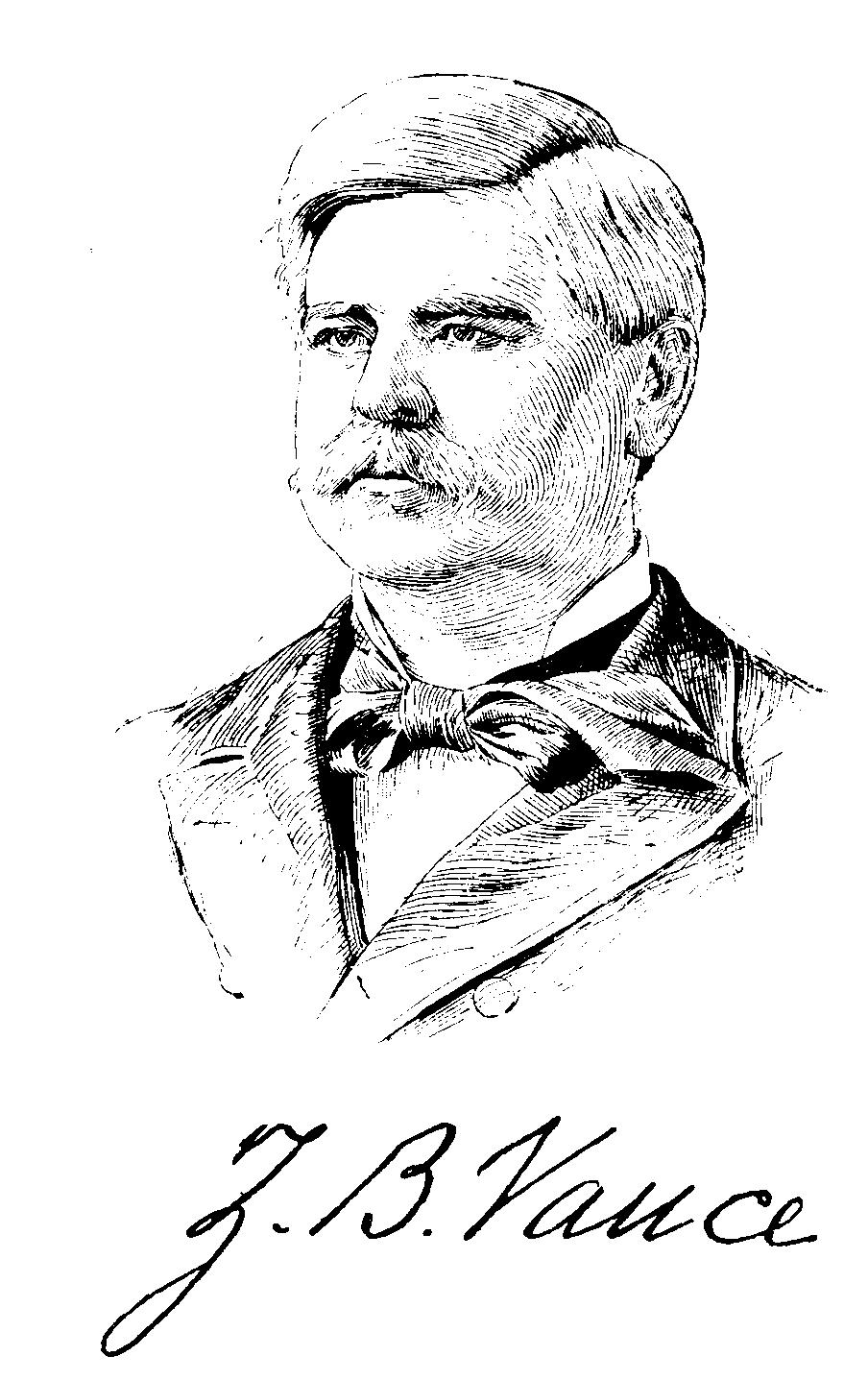
VANCE, Zebulon Baird, senator, born in Buncombe county, North Carolina. 13 May, 1830. He was educated at Washington college, Tennessee, and at the University of North Carolina, studied law, was admitted to the bar in 1852, established himself at Asheville, North Carolina, was chosen county solicitor, and in 1854 was elected to the legislature. When Thomas L. Clingman entered the senate. Vance was elected to succeed him in the house of representatives, taking his seat on 7 December, 1858. He opposed the secession of North Carolina, yet after that step was taken he raised a company and was chosen captain, and soon afterward was appointed colonel of the 26th North Carolina regiment, which became one of the most famous of the organizations of southern soldiers. In 1862 he was elected governor, while serving in the field. He soon saw the impossibility of obtaining sufficient supplies for the troops of his state without recourse to foreign aid, and therefore sent agents abroad, and purchased a fine steam ship in the Clyde, which successfully ran the blockade, not only supplying the state troops with clothing and arms, but furnishing also large stores for the use of the Confederate government and for the hospitals, and general supplies for the people of his state. As early as December, 1863, perceiving the desperate nature of the undertaking in which the south was engaged, he urged President Davis to neglect no opportunity of negotiation with the United States government, but at the same time he was so earnest and efficient in contributing men and material for the support of the cause that, he was called the war governor of the south. He was also conspicuous in his efforts to ameliorate the condition of Federal prisoners in his state. He was overwhelmingly re-elected for the next two years in 1864. When the National troops occupied North Carolina, Governor Vance was arrested and taken to Washington, D. C., where he was confined in prison for several weeks. In November, 1870, he was elected United States senator by the legislature, but he was not allowed to take his seat, and resigned it in January, 1872. In the same year he was again a candidate for a senatorship, but was defeated by Augustus S. Merrimon, to whom the Republicans gave their votes. He received a pardon from President Johnson in 1867, and his political disabilities were removed by congress in 1872. Soon after he had been refused a seat in the United States senate by reason of those disabilities. He continued to practise law in Charlotte, taking no part in politics, except his conspicuous efforts as a private citizen to overthrow the reconstruction government in North Carolina. In 1876, after an animated canvass, he was elected governor by a large majority, lie resigned on being again elected United States senator, took his seat on 4 March, 1879, and by his wit and eloquence soon acquired a high rank among the Democratic orators of the senate. In 1884 he was re-elected for the term ending on 4 March, 1891.
Unauthorized Site:
This site and its contents are not affiliated, connected,
associated with or authorized by the individual, family,
friends, or trademarked entities utilizing any part or
the subject's entire name. Any official or affiliated
sites that are related to this subject will be hyper
linked below upon submission
and Evisum, Inc. review.
Please join us in our mission to incorporate The Congressional Evolution of the United States of America discovery-based curriculum into the classroom of every primary and secondary school in the United States of America by July 2, 2026, the nation’s 250th birthday. , the United States of America: We The
People. Click Here